
Google GCP-PSOE Study Guide: Pass with Confidence

The Google Professional Security Operations Engineer (GCP-PSOE) certification validates an individual's expertise in designing, implementing, and managing security operations within Google Cloud environments. This credential is vital for professionals tasked with safeguarding cloud infrastructure, demonstrating proficiency in threat detection, incident response, and security platform management. Intended for experienced security engineers, the GCP-PSOE exam, designated by code GCP-PSOE, assesses a candidate's ability to leverage Google Cloud security tools and best practices to protect organizational assets. This comprehensive guide will equip you with essential insights into the exam structure, key syllabus areas, effective preparation strategies, and crucial resources to help you confidently achieve this esteemed certification from Google.
Grasping the GCP-PSOE Credential Details
Earning the Google Professional Security Operations Engineer certification signifies a high level of skill in managing and optimizing security operations on Google Cloud. Understanding the practical aspects of the GCP-PSOE exam is a critical first step for any aspiring candidate. This involves familiarizing oneself with the administrative and logistical details that frame the examination experience.
Key details for the GCP-PSOE exam include:
-
Exam Name: Google Professional Security Operations Engineer (GCP-PSOE)
-
Exam Code: GCP-PSOE
-
Exam Price: $200 USD
-
Duration: Candidates are allotted 120 minutes to complete the examination.
-
Number of Questions: The exam comprises 50-60 multiple-choice and multiple-select questions.
-
Passing Score: The exam is graded on a Pass / Fail basis, with an approximate passing score of 70%.
These details establish the framework within which candidates must prepare, allowing for focused study and realistic expectations regarding the examination process.
Unpacking the GCP-PSOE Syllabus Domains
The Google Professional Security Operations Engineer exam covers a breadth of topics essential for effective security operations in Google Cloud. A deep understanding of these domains, along with their respective weightages, is fundamental for targeted preparation. Each section of the syllabus focuses on critical skills that a Security Operations Engineer must possess to detect, prevent, and respond to security threats efficiently.
The exam focuses on the following primary areas:
-
Platform Operations - 14%
This domain evaluates a candidate's ability to operate and manage the underlying security platforms within Google Cloud. It includes tasks like configuring and maintaining security tools, ensuring their optimal performance, and integrating them into broader security workflows. -
Data Management - 14%
Candidates must demonstrate proficiency in managing security-related data, including logs, metrics, and incident data. This involves understanding data ingestion, storage, retention policies, and ensuring data integrity and accessibility for analysis. -
Threat Hunting - 19%
A significant portion of the exam assesses skills in proactive threat hunting. This involves using various tools and techniques to identify hidden threats, patterns of malicious activity, and potential vulnerabilities that automated systems might miss. -
Detection Engineering - 22%
This is the most heavily weighted domain, focusing on the design, development, and deployment of effective detection rules and mechanisms. It covers creating custom alerts, tuning existing detections, and ensuring robust monitoring capabilities for various attack vectors. -
Incident Response - 21%
This section is crucial for evaluating a candidate's ability to respond to security incidents systematically. It includes incident identification, containment, eradication, recovery, and post-incident analysis, adhering to established security incident management best practices. -
Observability - 10%
The observability domain addresses the importance of having comprehensive visibility into Google Cloud environments. It involves leveraging logging, monitoring, and tracing tools to understand system behavior, identify anomalies, and support security investigations.
A balanced approach to these domains, paying particular attention to the more heavily weighted areas like Detection Engineering and Incident Response, is crucial for success.
The Strategic Value of GCP-PSOE Certification
Pursuing the Google Professional Security Operations Engineer certification offers substantial career advantages and professional validation. It is not merely a credential but a testament to a practitioner's ability to secure complex cloud environments against evolving threats. This certification addresses the critical industry demand for skilled professionals who can navigate the intricacies of cloud security operations, providing a clear differentiator in the competitive tech landscape.
Individuals holding this certification demonstrate a proven capacity to implement Google Cloud security monitoring and logging solutions, manage incidents effectively, and apply advanced threat detection techniques. It enhances credibility, signaling to employers a commitment to mastering Google Cloud's security ecosystem. This can open doors to specialized roles, leadership opportunities, and often, improved compensation.
Identifying the Ideal GCP-PSOE Candidate Profile
The Google Professional Security Operations Engineer certification is specifically designed for security professionals with hands-on experience in cloud environments. Ideal candidates are those actively engaged in protecting, monitoring, and responding to security incidents within Google Cloud. This role demands a proactive mindset, technical depth, and a comprehensive understanding of both defensive and offensive security principles.
Typically, this exam is suitable for:
-
Experienced security analysts seeking to specialize in Google Cloud.
-
Security engineers are responsible for implementing and managing cloud security tools.
-
Incident responders focused on cloud-native security breaches.
-
Professionals involved in threat detection and security monitoring of GCP resources.
-
Cloud architects looking to deepen their expertise in security operations.
Candidates should possess a foundational understanding of Google Cloud infrastructure and services, coupled with significant experience in general security operations.
Essential Skills Validated by the Exam
The GCP-PSOE certification validates a comprehensive set of skills crucial for effective security operations in Google Cloud. These skills span technical proficiency, analytical capability, and strategic thinking, ensuring that certified professionals can handle a wide array of security challenges. The exam tests a candidate's practical application of knowledge, not just theoretical understanding.
Key skills evaluated include:
-
Threat Modeling and Analysis: The ability to identify potential threats, vulnerabilities, and attack vectors specific to cloud environments.
-
Security Control Implementation: Expertise in deploying and configuring various Google Cloud security services and tools, such as Security Command Center, Chronicle Security Operations, and Cloud Armor.
-
Detection Rule Engineering: Developing and refining rules for security information and event management (SIEM) systems and security analytics platforms to accurately identify malicious activity.
-
Incident Management: Skill in following a structured approach to incident response, from initial detection and triage to containment, eradication, recovery, and post-mortem analysis.
-
Logging and Monitoring: Proficiency in setting up robust Google Cloud security monitoring and logging solutions, including using Cloud Logging, Cloud Monitoring, and Audit Logs for forensic analysis.
-
Automation and Orchestration: Leveraging automation to streamline security operations tasks, improve response times, and reduce manual effort in repetitive processes.
These proficiencies collectively enable a security operations engineer to build and maintain a strong security posture on Google Cloud.
Crafting an Effective GCP-PSOE Study Plan
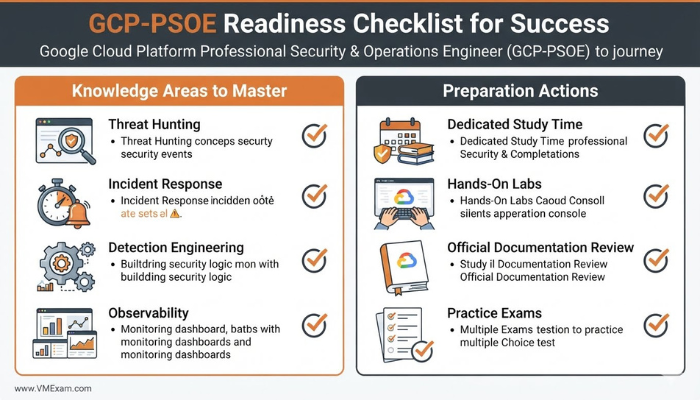
Successful preparation for the Google Professional Security Operations Engineer exam requires a structured and consistent study plan. Given the breadth and depth of the syllabus, a haphazard approach is unlikely to yield the desired results. A well-thought-out plan helps in organizing resources, managing time effectively, and ensuring comprehensive coverage of all exam domains.
Time Management and Consistency
Allocate dedicated study time each day or week, treating it as a non-negotiable appointment. Consistency is more important than cramming, as it allows for better retention and a deeper understanding of complex topics. Break down your overall study period into smaller, manageable chunks, focusing on one or two syllabus domains at a time. Regularly review previously covered material to reinforce learning and identify areas requiring further attention.
Curating Learning Resources
Beyond official documentation, consider a variety of learning materials. This might include online courses, video tutorials, and reputable third-party study guides. While focusing on quality over quantity, diversify your resources to gain different perspectives on the same topic. Engage with community forums or study groups to discuss challenging concepts and gain insights from peers.
Mastering Google Cloud Security Operations Concepts
To pass the GCP-PSOE exam, a profound understanding of Google Cloud's security services and their operational nuances is non-negotiable. This involves not only knowing what each service does but also how to effectively implement and integrate them into a cohesive security operations strategy. Each syllabus domain demands a dedicated focus to ensure mastery.
Platform Operations Foundations
Understanding how to manage the Google Cloud security platform is foundational. This includes configuring IAM policies, managing organizations and projects securely, and understanding service accounts. Proficiency extends to setting up and managing key Google Cloud security tools like Security Command Center (SCC) for vulnerability management and threat detection, ensuring proper integrations and data flows. Candidates should be adept at configuring network security services such as Cloud Firewall rules, VPC Service Controls, and Cloud Load Balancing with security policies.
Data Management Best Practices
Effective security operations heavily rely on robust data management. This involves understanding how to collect, store, and analyze security logs and telemetry from various Google Cloud services using Cloud Logging. Candidates must know how to export logs to central repositories like BigQuery or Cloud Storage for long-term retention and advanced analytics. Additionally, understanding data residency, encryption at rest and in transit, and data access controls are crucial for maintaining compliance and data integrity.
Proactive Threat Hunting Techniques
Threat hunting is a proactive approach to discovering unknown threats lurking in the environment. For the GCP-PSOE exam, this involves leveraging Google Cloud's rich telemetry and analytics capabilities. Learn to use BigQuery for log analysis, identify suspicious patterns, and create custom queries to uncover anomalies. Familiarity with security intelligence feeds and how to integrate them into your hunting process is also important, along with understanding how to pivot between different data sources during an investigation.
Advanced Detection Engineering
Detection engineering is about building robust and accurate detection capabilities. This means developing custom detection rules in Google Cloud Security Command Center, Chronicle Security Operations, or other SIEM solutions. Focus on understanding rule syntax, optimizing rule performance, and minimizing false positives. Emphasize the lifecycle of a detection rule, from creation and testing to deployment and continuous refinement based on real-world events. Mastering the art of writing effective YARA or Sigma rules for specific threat patterns is highly beneficial.
Effective Incident Response Strategies
When an incident occurs, a structured response is paramount. This domain requires understanding the incident response lifecycle: preparation, identification, containment, eradication, recovery, and post-incident activity. Practice using Google Cloud tools for incident investigation, such as Cloud Audit Logs for forensics, Cloud Shell for immediate action, and Security Command Center for identifying impacted assets. Developing playbooks for common incident types and understanding communication protocols during a breach are key skills for incident management best practices in the cloud.
Optimizing Observability for Security
Observability provides the visibility needed to understand the health and security posture of your Google Cloud environment. This involves configuring comprehensive logging for all services, setting up effective monitoring dashboards with Cloud Monitoring, and leveraging tracing for distributed applications. Learn to create custom metrics and alerts that indicate potential security issues. Understanding how to use these tools to gain deep insights into system behavior and quickly identify deviations from the baseline is critical for proactive security.
Importance of Hands-On Experience
Theoretical knowledge is essential, but practical application is where real understanding solidifies. For the GCP-PSOE exam, hands-on experience with Google Cloud security services is indispensable. Setting up a personal GCP project, experimenting with different security tools, and simulating various scenarios will reinforce your learning significantly. Focus on configuring logging and monitoring, deploying detection rules, and practicing incident response procedures in a live environment. This experiential learning will bridge the gap between concepts and real-world implementation.
Leveraging Official GCP-PSOE Resources
Google provides a wealth of official resources specifically designed to support candidates for the Professional Security Operations Engineer certification. These resources are authoritative and align directly with the exam objectives, making them invaluable for your preparation. Consulting official documentation ensures you are studying the most accurate and up-to-date information.
Key official resources include:
-
The official Google Cloud Professional Security Operations Engineer certification page, which provides the latest exam guide, registration details, and recommended learning paths.
-
Google Cloud documentation for specific security services (e.g., Security Command Center, Chronicle Security Operations, Cloud Audit Logs, IAM).
-
Google Cloud training courses and labs focused on security operations are often available through platforms like Coursera or Google Cloud Skills Boost.
-
Case studies and best practices guides published by Google, offering real-world insights into security implementations.
Regularly reviewing these materials will provide a solid foundation and ensure your study efforts are well-directed.
Simulating the Exam with Practice Tests
Once you have covered the syllabus topics and gained hands-on experience, practice tests become an invaluable tool for gauging your readiness. Taking full-length practice exams helps you become familiar with the question format, identify areas of weakness, and improve your time management skills under pressure. It's an opportunity to simulate the actual exam environment and build confidence.
Platforms like VMExam offer Google GCP-PSOE practice test options that can help you evaluate your understanding of the material. By reviewing your performance on these tests, you can pinpoint specific topics that require further study and refine your test-taking strategy. Focus not just on getting the right answer, but on understanding the underlying concepts behind both correct and incorrect responses.
Navigating the Exam Day
Effective preparation extends beyond studying to include proper exam day logistics. Ensure you have a stable internet connection and a quiet environment if taking the exam remotely. Log in early to complete any necessary setup and system checks. During the exam, read each question carefully, paying attention to keywords and specific requirements. Manage your time wisely, and don't spend too long on a single difficult question; mark it for review if needed and return later. Trust your preparation and approach the exam with a calm, focused mindset.
Upholding Exam Integrity
While preparing for the Google GCP-PSOE exam, it is crucial to adhere to ethical study practices. Relying on unauthorized "brain dump" materials not only undermines the value of your certification but can also lead to serious repercussions from Google. These resources often contain outdated or incorrect information, providing a false sense of security and potentially hindering your true understanding of the subject matter. Focus on genuine learning, hands-on experience, and reputable study guides to ensure long-term competency and the integrity of your certification.
Long-term Career Trajectory with GCP-PSOE
Achieving the Google Professional Security Operations Engineer certification is a significant milestone that can profoundly impact your career trajectory. This credential demonstrates not just technical skills but also a commitment to professional growth and specialization in a high-demand field. As cloud adoption continues to grow, so does the need for experts who can secure these complex environments. Certified individuals are well-positioned for leadership roles, contributing to critical security initiatives and guiding organizations in their cloud security journey.
Beyond initial career advancement, the GCP-PSOE certification fosters a mindset of continuous learning, which is essential in the rapidly evolving cybersecurity landscape. It signals that you are an adaptive and knowledgeable professional, ready to tackle the next generation of cloud security challenges. This ongoing relevance ensures that your investment in certification continues to yield substantial dividends throughout your professional life.
Conclusion
The Google GCP-PSOE certification is a rigorous yet highly rewarding credential for security operations engineers working with Google Cloud. It validates a critical skill set in an increasingly vital domain, distinguishing professionals capable of building and maintaining robust security postures. By diligently following a structured study plan, leveraging official resources, and gaining hands-on experience, you can approach the exam with confidence and secure your place among Google Cloud's elite security professionals.
Embark on your certification journey by exploring comprehensive study materials and practice exams. For effective preparation, consider utilizing reliable platforms that offer quality resources to test your knowledge and readiness. Visit VMExam for a robust selection of practice tests and study tools tailored to enhance your exam confidence.
FAQs
1. What is the Google GCP-PSOE certification about?
The Google GCP-PSOE certification validates a professional's ability to design, implement, and manage security operations, including threat detection, incident response, and security platform management, within Google Cloud environments.
2. Who should consider taking the Google Professional Security Operations Engineer exam?
This exam is ideal for experienced security analysts, engineers, and incident responders who are actively involved in protecting, monitoring, and responding to security incidents in Google Cloud.
3. What are the core domains covered in the GCP-PSOE exam syllabus?
The exam covers platform operations, data management, threat hunting, detection engineering, incident response, and observability, with detection engineering and incident response being the most heavily weighted areas.
4. Is hands-on experience necessary to pass the Google GCP-PSOE exam?
Yes, hands-on experience with Google Cloud security services is critical. The exam assesses the practical application of knowledge, so theoretical understanding should be complemented with real-world practice.
5. What is the approximate cost and duration of the Google GCP-PSOE exam?
The Google GCP-PSOE exam costs $200 USD and has a duration of 120 minutes. It consists of 50-60 multiple-choice and multiple-select questions.
- Google Professional Certification |
- GCP-PSOE |
- GCP-PSOE Mock Test |
- GCP-PSOE Practice Exam |
- GCP-PSOE Prep Guide |
- GCP-PSOE Questions |
- GCP-PSOE Simulation Questions |
- Google Cloud Platform - Professional Security Operations Engineer (GCP-PSOE) Questions and Answers |
- GCP-PSOE Online Test |
- Google GCP-PSOE Study Guide |
- Google GCP-PSOE Exam Questions |
- Google GCP-PSOE Cert Guide |
- GCP-PSOE Certification Mock Test |
- Professional Security Operations Engineer Simulator |
- Professional Security Operations Engineer Mock Exam |
- Google Professional Security Operations Engineer Questions |
- Professional Security Operations Engineer |
- GCP-PSOE Books |
- GCP-PSOE Exam Cost |
- GCP-PSOE Passing Score |
- GCP-PSOE Syllabus |
- Google Cloud Platform - Professional Security Operations Engineer (GCP-PSOE) |
- GCP-PSOE Exam Prep Guide |
- GCP-PSOE Exam Price |
- GCP-PSOE Training |
- Google GCP-PSOE Training |
- Professional Security Operations Engineer Certification Cost |
- Google Professional Security Operations Engineer Books


