
Beyond Code: What Appian ACD-101 Truly Validates
The Appian ACD-101 certification, formally known as the Appian Certified Associate Developer exam, serves as a pivotal credential that validates a candidate's foundational proficiency in designing, building, and deploying low-code applications on the Appian platform. This certification is specifically tailored for individuals aiming to demonstrate their core understanding of Appian's development environment, including process modeling, interface design, data management, and expression rules. Professionals aspiring to become proficient low-code developers, business analysts, or technical consultants leveraging Appian technology will find this credential essential for establishing their credibility and opening doors to specialized roles. This comprehensive article delves into what the Appian ACD-101 truly signifies, outlining its structure, key knowledge areas, and strategic preparation advice to empower your certification journey.
Ascertaining Core Appian Development Competence
The Appian ACD-101 exam rigorously assesses an individual’s ability to navigate the Appian platform and implement fundamental application components effectively. Earning this certification confirms that a developer possesses the practical skills to contribute to low-code projects, understanding not just the syntax but the core principles of the Appian development methodology. It signifies a readiness to participate in real-world Appian initiatives, translating business requirements into functional, efficient applications with minimal code. This validation covers essential skills necessary for creating user-friendly interfaces, robust process flows, and effective data structures within the Appian ecosystem.
Appian ACD-101 Certification Essentials
Understanding the logistics of the Appian ACD-101 exam is the first step towards successful certification. This assessment is designed to be a comprehensive, yet focused, evaluation of your practical knowledge. Key details about the exam structure include:
-
Exam Name: Appian Certified Associate Developer
-
Exam Code: ACD-101
-
Exam Price: The cost to take the exam is $250 USD, a standard investment for a credential validating specialized low-code development skills.
-
Duration: Candidates are allotted 60 minutes to complete the exam, requiring efficient time management alongside accurate knowledge recall.
-
Number of Questions: The exam consists of 60 multiple-choice questions, testing a broad range of Appian platform concepts and development practices.
-
Passing Score: A minimum score of 73% is required to pass the ACD-101 exam and achieve the certification, emphasizing the importance of thorough preparation across all topic areas.
This structured format ensures that certified individuals possess a well-rounded understanding of Appian’s capabilities, reinforcing the value of the credential in the fast-evolving low-code landscape. For more official insights into the certification process, you can consult the Appian certification guide directly from the vendor.
Exploring Fundamental Appian Platform Concepts
The Appian platform is built on a set of core principles that guide effective low-code application development, and the ACD-101 certification ensures candidates grasp these foundational concepts. Beyond merely knowing how to use specific tools, certified associate developers understand the "why" behind Appian's design philosophy. This includes appreciating the platform's emphasis on user experience, process automation, and seamless data integration, which are crucial for building scalable and maintainable enterprise applications.
General Appian Principles and Introduction to the Platform
A significant portion of the Appian ACD-101 exam focuses on the overarching principles that govern application design and execution within the Appian ecosystem. This foundational knowledge is crucial for any developer aiming to build efficient and impactful solutions.
-
Introduction to the Appian platform (14%): This section covers the fundamental architecture, key components, and overarching benefits of using Appian for low-code development. It ensures candidates understand where Appian fits in the enterprise technology landscape and its primary use cases.
-
General Appian principles (9%): This domain delves into the core tenets of Appian development, such as the importance of design thinking, reusability, modularity, and object-oriented concepts applied within a low-code context. It also touches upon security considerations and performance best practices.
These sections lay the groundwork for understanding how individual components interact and contribute to a holistic application, preparing developers to build more than just isolated features.
Mapping Key Skill Domains for Appian Associate Developers
The Appian ACD-101 syllabus is carefully structured to cover the diverse skill sets required for an entry-level Appian developer. Each domain represents a critical area of low-code application construction, from defining business logic to designing compelling user interfaces and managing application data. Proficiency across these topics ensures a developer can build functional, user-centric solutions.
ACD-101 Exam Syllabus Breakdown
The exam systematically assesses knowledge across several key areas, with specific weightages assigned to each:
|
Syllabus Topics |
Weightage |
Focus Area |
|---|---|---|
|
Introduction to the Appian platform |
14% |
Covers basic navigation, understanding the development environment, and core capabilities of Appian. |
|
General Appian principles |
9% |
Focuses on best practices, application design methodology, and fundamental concepts that underpin all Appian development. |
|
Data persistence |
13% |
Deals with creating and managing data stores, record types, and connecting applications to various data sources. |
|
Appian development: Process models |
17% |
Emphasizes designing and implementing automated business processes, including tasks, gateways, and events. |
|
Appian development: Interface design |
19% |
Concentrates on building intuitive and responsive user interfaces using SAIL (Self-Assembling Interface Layer) components. |
|
Appian development: Records |
13% |
Explores leveraging Appian Records for powerful data aggregation, filtering, and displaying related information. |
|
Appian development: Expression rules |
15% |
Involves writing logical expressions to define dynamic behavior, calculations, and data manipulation within applications. |
These weighted sections provide a clear roadmap for study, highlighting areas where a deeper understanding is particularly critical for passing the exam and excelling as an Appian developer.
Cultivating Foundational Appian Design Skills
Effective Appian development hinges on the ability to translate business needs into well-structured process models and intuitive interfaces. The ACD-101 certification places a strong emphasis on these core design capabilities, ensuring that developers can not only automate tasks but also create engaging user experiences. Mastering these areas is fundamental for building applications that are both functional and widely adopted by end-users.
Designing User Interfaces and Process Workflows
Interface design and process modeling are two pillars of Appian application development. The exam ensures candidates can skillfully navigate these areas.
Appian Development: Interface Design (19%)
This domain is crucial for creating applications that are not just functional but also user-friendly and aesthetically pleasing. Candidates must demonstrate proficiency in:
-
Utilizing SAIL components effectively to construct dynamic forms, reports, and dashboards.
-
Applying best practices for responsive design to ensure interfaces adapt across various devices.
-
Understanding how to integrate user inputs and display relevant information clearly and concisely.
The ability to craft compelling interfaces directly impacts user adoption and overall application success.
Appian Development: Process Models (17%)
Process models are the heart of automation in Appian, defining the flow of work and decisions within an application. This section tests knowledge of:
-
Designing robust and efficient process flows, including human tasks, system integrations, and decision points.
-
Implementing complex logic using gateways, events, and sub-processes to manage diverse business scenarios.
-
Monitoring and troubleshooting process instances to ensure smooth operation and identify bottlenecks.
A strong grasp of process modeling allows developers to automate complex business operations, reducing manual effort and improving organizational efficiency.
Mastering Data Persistence and Expression Logic
Beyond visual design, a powerful Appian application requires robust data management and dynamic logic. The ACD-101 exam deeply probes a candidate's understanding of how data is stored, retrieved, and manipulated within the Appian environment, as well as their ability to write effective expressions. These technical skills form the backbone of any sophisticated low-code solution, enabling complex calculations, conditional behaviors, and efficient data handling.
Handling Data and Dynamic Behaviors in Appian
The accurate and efficient management of data, combined with dynamic expression rules, allows Appian applications to respond intelligently to user input and business changes.
Data Persistence (13%)
This module focuses on how data is managed and structured within Appian applications. Key areas include:
-
Creating and configuring data stores: Understanding how to connect Appian to external databases and define data sources.
-
Designing and utilizing record types: Structuring data effectively for consumption within Appian, including relationships and security.
-
Managing data relationships: Ensuring data integrity and efficient retrieval through proper data modeling.
Proficiency here guarantees that applications can interact seamlessly with underlying data, providing accurate and timely information to users.
Appian Development: Records (13%)
Appian Records transform raw data into actionable business information, providing a unified view of related data. This section covers:
-
Configuring record types: Setting up data relationships, security, and smart services for data manipulation.
-
Building record interfaces: Designing summary views, list views, and related actions for comprehensive data interaction.
-
Leveraging record features: Utilizing filters, user filters, and search functionalities to enhance data accessibility.
Records are essential for creating data-driven applications that provide insightful and integrated views for business users.
Appian Development: Expression Rules (15%)
Expression rules are the core of Appian's logic engine, enabling dynamic content, calculations, and conditional behaviors. This area tests:
-
Writing efficient and reusable expressions: Crafting clear, concise, and optimized rules using Appian's extensive function library.
-
Understanding expression rule types: Differentiating between interface expressions, query rules, and validation rules.
-
Debugging and testing expressions: Ensuring accuracy and preventing errors in application logic.
Strong expression rule skills are vital for building intelligent and adaptive Appian applications.
Strategic Preparation for the Appian ACD-101 Exam
Achieving the Appian Certified Associate Developer credential requires a methodical and focused preparation strategy. It's not enough to simply understand the concepts; candidates must also be familiar with the exam format and apply their knowledge to practical scenarios. Effective study involves a combination of official resources, hands-on practice, and structured review. Additionally, consider dedicated Appian ACD-101 practice exams to test your readiness.
Building a Robust Study Plan
A well-structured study plan is indispensable for covering the breadth of the ACD-101 syllabus.
-
Review Official Documentation: Start with Appian's official documentation and learning modules on their community site. These resources are designed by Appian experts and align directly with exam objectives.
-
Hands-On Practice: The best way to learn Appian is by doing. Utilize the Appian Community Edition to build sample applications, experiment with different components, and reinforce theoretical knowledge through practical application.
-
Focus on Weak Areas: Identify sections of the syllabus where your understanding is weakest and allocate more study time to those specific domains. For instance, if data persistence is challenging, dedicate extra effort to creating complex record types and data stores.
-
Practice with Sample Questions: Engage with sample questions to get accustomed to the exam's question style and format. This helps in understanding how concepts are tested and in improving time management during the actual exam.
Furthermore, actively participating in developer communities can provide valuable insights and peer support. You can join the vibrant Appian community discussions to ask questions and learn from experienced developers.
Advancing Your Career with Appian Certification
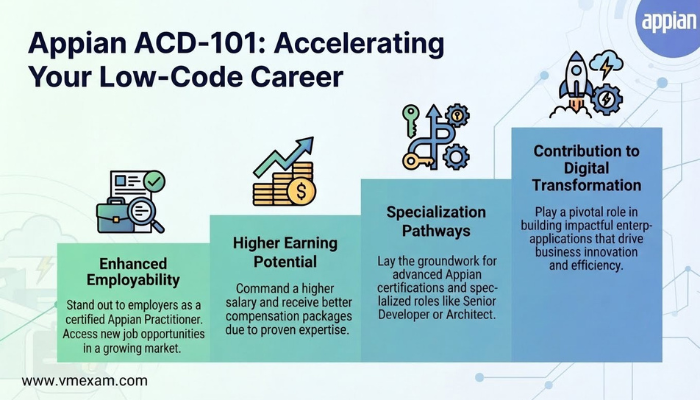
Earning the Appian Certified Associate Developer credential goes beyond mere technical validation; it significantly enhances a professional’s career trajectory in the burgeoning low-code market. As organizations increasingly adopt Appian for digital transformation, certified individuals are highly sought after for their proven ability to deliver business-critical applications efficiently. This certification signals to employers a commitment to professional growth and a validated skill set ready to contribute immediate value.
Realizing Professional Growth and Opportunity
The Appian ACD-101 certification equips professionals with the credentials needed to seize new opportunities.
-
Enhanced Employability: Certified individuals stand out in a competitive job market, as employers seek candidates who can immediately contribute to Appian projects.
-
Higher Earning Potential: Validated skills often correlate with increased salary expectations, reflecting the demand for specialized Appian expertise.
-
Career Specialization: The ACD-101 serves as a stepping stone to more advanced Appian certifications and specialized roles, such as Lead Developer, Architect, or Technical Project Manager.
-
Contribution to Digital Transformation: With Appian skills, professionals are at the forefront of helping organizations streamline processes, improve customer experiences, and drive innovation through low-code solutions.
Networking within the Appian ecosystem is also crucial for career advancement. Consider taking the time to engage with professionals in the Appian Developers LinkedIn group to expand your professional network and discover new opportunities.
Beyond the Exam: Applying Appian Expertise
The true value of the Appian ACD-101 certification lies in the practical application of the validated skills. It's not just about passing a test; it's about confidently leveraging the Appian platform to solve real-world business challenges. Certified professionals are empowered to design and implement solutions that genuinely impact organizational efficiency, user experience, and strategic objectives. This applied expertise translates directly into measurable success for projects and career growth for the individual.
Leveraging Your Certified Skills in Practice
After certification, the focus shifts to continuously applying and expanding Appian expertise.
-
Participate in Diverse Projects: Seek out opportunities to work on various Appian projects, ranging from simple departmental applications to complex enterprise-wide solutions. This exposure helps to broaden your understanding and application of the platform.
-
Continuous Learning and Adaptation: The low-code landscape, and Appian specifically, evolves rapidly. Stay updated with new features, best practices, and release notes to maintain relevance and maximize your skills.
-
Mentor and Share Knowledge: Engaging with newer developers, sharing your insights, and mentoring others not only reinforces your own understanding but also contributes to the growth of the broader Appian community.
-
Advocate for Low-Code Solutions: Use your expertise to identify areas within your organization or client environments where Appian can deliver significant value, championing the adoption of low-code development.
The ACD-101 certificate is a strong starting point, but ongoing engagement and practical application are key to long-term success and becoming a truly impactful Appian professional.
The Appian ACD-101 certification stands as a testament to a developer's fundamental competence in the Appian low-code platform. It validates not just theoretical knowledge but the practical skills essential for designing, building, and deploying effective enterprise applications. By focusing on critical domains like process modeling, interface design, data persistence, and expression rules, the exam ensures that certified professionals are well-equipped to contribute meaningfully to digital transformation initiatives. This credential is an invaluable asset for anyone looking to establish a credible foundation in Appian development and accelerate their career in the dynamic low-code arena.
Ready to solidify your skills and prepare for success? For a deeper dive into certification pathways and preparation, explore trusted exam preparation materials to begin your journey.
FAQs
1. What specific skills does the Appian ACD-101 certification validate?
The Appian ACD-101 certification validates foundational skills in designing and building low-code applications on the Appian platform, specifically covering process modeling, interface design (SAIL), data persistence, Appian Records, and expression rules.
2. Who should consider taking the Appian ACD-101 exam?
This certification is ideal for aspiring low-code developers, business analysts, or technical consultants who are new to the Appian platform and wish to formally validate their fundamental understanding and practical application skills.
3. What is the format of the Appian ACD-101 exam, and how many questions are there?
The Appian ACD-101 exam consists of 60 multiple-choice questions, and candidates are given 60 minutes to complete the assessment. A passing score of 73% is required.
4. How can I best prepare for the Appian ACD-101 certification exam?
Effective preparation includes reviewing official Appian documentation, hands-on practice using the Appian Community Edition, focusing on weaker syllabus areas, and utilizing practice exams to familiarize yourself with question types and time constraints.
5. What are the career benefits of obtaining the Appian ACD-101 certification?
Achieving the Appian ACD-101 certification enhances employability, potentially increases earning potential, opens doors to specialized Appian roles, and positions professionals to contribute significantly to digital transformation projects within organizations leveraging low-code technology.
- Associate Developer |
- Associate Developer Mock Test |
- Appian Certified Associate Developer Questions and Answers |
- Associate Developer Online Test |
- Appian Associate Developer Exam Questions |
- Appian Developer Certification |
- Appian Associate Developer Cert Guide |
- Associate Developer Certification Mock Test |
- Associate Developer Simulator |
- Associate Developer Mock Exam |
- Appian Associate Developer Questions |
- Appian Associate Developer Practice Test |
- Appian Certified Associate Developer |
- Associate Developer Exam Prep Guide |
- Associate Developer Exam Price |
- Associate Developer Training |
- Appian Associate Developer Training |
- Associate Developer Certification Cost |
- Appian Associate Developer Books |
- Appian Associate Developer Certification |
- Associate Developer Study Guide |
- Associate Developer Certification Sample Questions |
- ACD-101 Associate Developer |
- ACD-101 Mock Test |
- ACD-101 Practice Exam |
- ACD-101 Prep Guide |
- ACD-101 Questions |
- ACD-101 Simulation Questions |
- ACD-101 |
- Appian ACD-101 Study Guide |
- ACD-101 Books


