
VMware Cloud Foundation 9.0: Key Skills for IT Administrators
A VMware Cloud Foundation 9.0 administrator keeps a private cloud running after it is built. The job covers deploying workload domains, managing identity, certificates, passwords and licences, patching the platform through lifecycle management, watching health in VCF Operations and handing out self-service resources through VCF Automation. Broadcom validates these skills with the VCP-VCF Admin certification.
The exam for that credential is 2V0-17.25, VMware Cloud Foundation 9.0 Administrator. Rather than repeat generic study advice, this article walks through the work itself: the tasks a Cloud Foundation administrator handles in a normal month, the tools used for each one, and the mistakes that cause outages. Each section maps to objectives in the published syllabus, so the same reading serves the job and the exam.
What does a VMware Cloud Foundation 9.0 administrator do in a normal week?
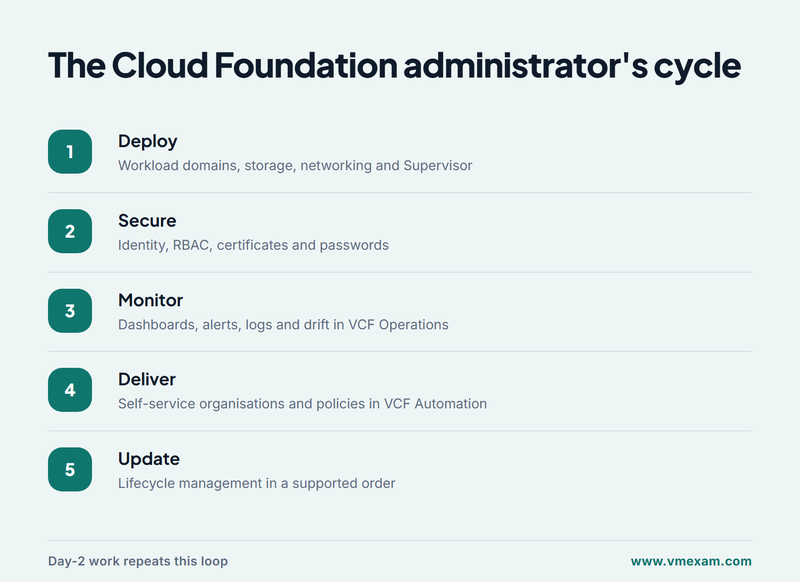
A Cloud Foundation administrator spends most of the week on day-2 operations: everything that happens after the first deployment. Monday might start with a review of overnight alerts in VCF Operations, followed by a request from an application team for a new namespace or a larger project quota. Midweek brings a certificate that expires in thirty days, a password rotation that a compliance scan flagged, or a new cluster that needs adding to an existing workload domain. By Friday the administrator is often preparing an upgrade bundle or a maintenance window for the following weekend.
The difference from a classic vSphere administrator is scope. Cloud Foundation brings compute, storage, networking, operations and automation under one platform with one lifecycle. A change that used to touch only vCenter can now affect NSX, vSAN, VCF Operations and VCF Automation at the same time. The administrator therefore needs enough depth in each component to predict side effects, and enough discipline to make changes through the platform's own workflows rather than by hand.
The work is also more service-oriented than it used to be. Instead of building every virtual machine on request, the administrator configures regions, organisations, quotas and catalogue items so that teams can serve themselves within guardrails. Success is measured less by tickets closed and more by how rarely teams need to open one.
Finally, the administrator is the first line of defence on security and compliance. Identity providers, role-based access, certificate validity, password age and configuration drift all sit on the administrator's desk. Each of these is a named objective in the exam, which tells you how much weight Broadcom places on operational hygiene.
Which platform fundamentals must be solid before you touch Cloud Foundation?
Cloud Foundation is built on vSphere, vSAN and NSX, so an administrator who is shaky on those layers struggles with everything above them. The syllabus groups these basics under VMware Cloud Foundation Fundamentals, and they account for 17 objectives across four areas: private cloud vision, compute, storage and networking.
Private cloud vision
The first area asks you to describe the principles of a private cloud, identify its use cases and explain its value. In practice this is the language you use when a manager asks why the organisation runs Cloud Foundation at all: standardised infrastructure, self-service consumption, consistent security and a single lifecycle across the stack. Three objectives sit here.
Compute
The compute area covers deploying and configuring vCenter and ESX, configuring a vSphere cluster, and deploying and managing virtual machines through vCenter. These four objectives are familiar to anyone with vSphere experience, but the Cloud Foundation context changes the habits. Clusters are created as part of a workload domain, not freehand, and host settings should come from the platform's standard configuration rather than individual tweaks.
Storage
Storage carries six objectives, the most of the four fundamentals areas. You need to configure vSphere storage, describe when to use vSAN Express Storage Architecture (ESA) or vSAN Original Storage Architecture (OSA), deploy a vSAN cluster, configure storage policies, and explain resilience, data availability and space efficiency options. The practical skill is reading a requirement such as "tolerate one host failure with minimal capacity overhead" and choosing the storage policy that meets it.
Networking
Networking covers four objectives: telling apart the Cloud Foundation networking components, configuring virtual networking fabrics and features, configuring connectivity and routing, and configuring networking services. Administrators coming from a pure vSphere background usually find this the steepest area, because overlay networking, gateways and routing between segments behave differently from port groups on a distributed switch.
How is a Cloud Foundation 9.0 private cloud deployed and extended?
Deployment in Cloud Foundation follows a defined path, and the administrator's job is to know which component handles which step. The syllabus lists nine deploy-and-configure objectives, from identifying the components of a deployment to configuring Supervisor inside a workload domain.
The first decision is the deployment model. A Cloud Foundation private cloud can be built in different shapes depending on scale and existing infrastructure, and the exam presents scenarios where you choose the model that fits. Once the initial platform is up, additional components are required to complete it: operations and automation services that turn a set of clusters into a private cloud that teams can consume.
Networking is deployed as part of the platform, and the syllabus names two specific tasks: deploying VCF Networking and deploying and configuring a VCF Network Gateway. Administrators should be able to describe what each provides and where it sits in the traffic path between workloads and the outside network.
Workload domains are how the platform grows. Each workload domain groups clusters for a purpose, such as general workloads, a business unit or a set of regulated systems. The administrator deploys the domain, configures its storage and, where teams run Kubernetes, enables Supervisor so that namespaces and vSphere Kubernetes workloads can run alongside virtual machines.
A very common real-world task is bringing an existing environment into Cloud Foundation. The syllabus includes the tasks and processes required to import an existing vCenter. This matters because many organisations do not start with empty hardware; they convert estates that already run production. The administrator must check prerequisites, understand what the import changes and plan the work so that running workloads are not disturbed.
Which management tasks keep a Cloud Foundation fleet healthy and secure?
The VCF: Manage area holds seven objectives, and almost every one of them is a recurring task rather than a one-off. Missing any of them is a classic cause of avoidable outages.
- Fleet management: differentiating the fleet management capabilities in VCF Operations, which is where the administrator sees and manages the platform's own components across instances.
- Identity and RBAC: connecting an identity provider and assigning roles so that each person has exactly the access their job needs.
- Licence management: applying and tracking licences so that capacity and features stay within entitlement.
- Certificate management: replacing and renewing certificates before they expire, ideally through the platform rather than component by component.
- Password management: rotating and remediating passwords for platform accounts on a schedule that satisfies security policy.
- vCenter import: the tasks needed to bring an existing vCenter under Cloud Foundation management.
- Lifecycle management: planning and applying updates across the stack in a supported order.
Certificates and passwords deserve special attention. An expired certificate between management components can stop operations and automation services from talking to each other, and the symptom often looks like an unrelated failure. Administrators who keep a calendar of expiry dates and use the platform's built-in management for renewal avoid most of those incidents.
Lifecycle management is the other high-stakes task. Cloud Foundation is designed to update its components as a validated set, so the administrator's role is to check readiness, review prerequisites, schedule the window and follow the supported sequence. Updating a single component outside that process is a reliable way to end up with an unsupported combination.
How does an administrator use VCF Operations day to day?
VCF Operations is where the administrator spends a large part of each day, and the syllabus reflects that with 14 objectives, the largest single group in the exam. They range from describing the cluster components and deployment options of VCF Operations to configuring configuration drift detection.
Monitoring starts with the data model. The exam expects you to tell metrics, which change over time such as CPU usage, from properties, which describe an object such as its version or configuration. That distinction drives how views, reports, dashboards and alert definitions are built.
From there the administrator builds custom views and reports for regular reviews, creates and shares dashboards for operations staff and managers, and configures alerting so that the right people are told about the right problems. Good alerting is selective: too many alerts train people to ignore them, too few let real issues slip through. Policies in VCF Operations control which thresholds and analysis settings apply to which objects, and tuning them is an ongoing task.
Several specialised monitoring capabilities appear in the objectives. Log events are monitored in VCF Operations, and VCF Operations (Logs) has its own use case. VCF Health and Diagnostics checks the platform's own components. VCF Network Operations monitors networks, and VCF Storage Operations monitors vSAN storage. Applications can also be monitored, and security hardening and compliance can be tracked against benchmarks.
Configuration drift closes the loop. Once a standard configuration is agreed, drift detection shows where hosts or components have moved away from it, usually because someone made a quick fix by hand. Catching drift early keeps the estate consistent and makes upgrades predictable.
What does VCF Automation add to the administrator's job?
VCF Automation turns the platform into a service. Its section carries 12 objectives, and together they describe how an administrator sets up self-service consumption that is safe to hand to other teams.
The work starts with understanding the use case for VCF Automation and its components and deployment options. The administrator then configures a region, which ties consumption to the underlying infrastructure, and sets up multi-organisation tenancy so that separate teams or business units each get their own organisation with its own resources and rules.
Provider-level tasks come next: configuring provider networking and a provider content library that organisations can draw on. Inside each organisation, an organisational administrator configures organisational networks, creates and manages content such as templates and catalogue items, and applies governance policies that limit what users can deploy and how much.
Extensibility lets the administrator automate business processes around deployments, for example calling an approval step or registering a machine in another system. The syllabus also includes describing the deployment of Supervisor-based services, which brings Kubernetes-based services into the same consumption model.
The practical lesson is that automation shifts effort to the front. Time spent designing organisations, quotas and policies saves far more time later, because requests stop arriving as tickets and start arriving as governed self-service deployments.
How is the VCP-VCF Admin exam built, and where should study time go?
The VCP-VCF Admin exam has 60 questions, a 135-minute time limit and a passing score of 300 on a scale of 500. As of October 2026 the fee is USD 250, and the exam is booked through Pearson VUE. Broadcom lists two recommended courses: VMware Cloud Foundation: Build, Manage, and Secure, and VMware Cloud Foundation: Automate and Operate.
| Item | Detail |
|---|---|
| Exam code | 2V0-17.25 |
| Exam name | VMware Cloud Foundation 9.0 Administrator |
| Certification | VMware Certified Professional - VMware Cloud Foundation Administrator (VCP-VCF Admin) |
| Number of questions | 60 |
| Duration | 135 minutes |
| Passing score | 300 / 500 |
| Price | USD 250 (as of October 2026) |
| Delivery | Pearson VUE |
The exam summary does not publish percentage weightings, but counting the 59 listed objectives gives a sensible guide to where study time should go. VCF Operations leads with 14 objectives, VCF Automation follows with 12, deployment and configuration has 9, management has 7, and the four fundamentals areas together hold 17. The IT Architectures, Technologies and Standards section and the Plan and Design section list no objectives for this exam.
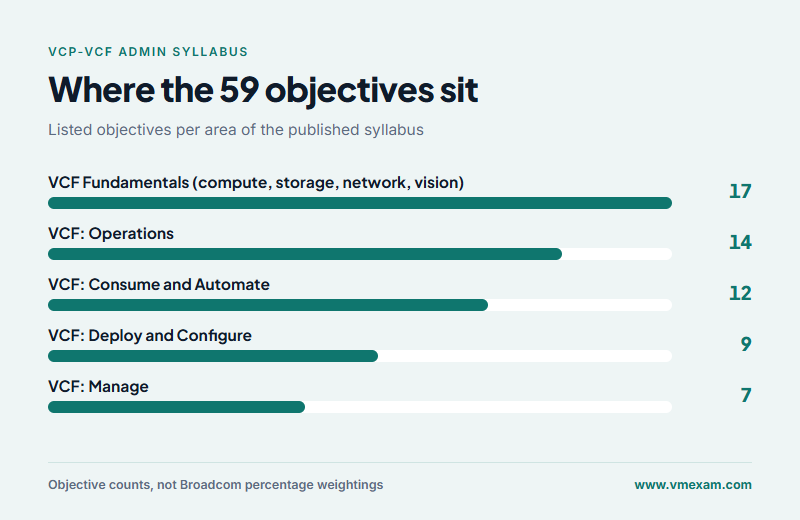
Two conclusions follow. First, operations and automation together make up more than four in ten of the listed objectives, so candidates who studied only deployment are underprepared. Second, the fundamentals still matter: 17 objectives on vSphere, vSAN and networking are too many to skip on the assumption that experience will carry you. The complete list is on the VCP-VCF Admin syllabus page, and the current exam rules are on Broadcom's VCP-VCF Administrator certification page.
Questions are mostly scenario-based. A typical item describes an environment and a goal, such as an application team that needs isolated networks and a spending limit, and asks which configuration achieves it. Reading the goal carefully matters more than memorising menu paths.
Does VMware by Broadcom offer an official practice test for VCF administrators?
Broadcom publishes the exam objectives, the exam details and its recommended courses on its certification pages. Check Broadcom's exam page for any preparation material it currently provides, because only the vendor's own material can be called official.
Our 2V0-17.25 practice test is an independent product, not Broadcom material, and it does not contain real exam questions. It provides timed, scenario-based questions mapped to the published objectives, with explanations for each answer. Use the recommended courses and a lab to learn the platform, then use practice questions to find weak objectives and get used to the time limit.
Avoid any source that claims to sell real exam questions. Beyond the risk to your certification, memorised answers fail quickly on scenario questions that test the same objective with different details.
How can a working administrator prepare in six weeks?
Most candidates already run vSphere and hold a full-time job, so the plan below assumes six to eight hours a week and access to a lab or test environment. Stretch it if Cloud Foundation is completely new to you.
- Week 1: fundamentals refresh. vSphere clusters and virtual machines, vSAN ESA and OSA, storage policies and space efficiency.
- Week 2: Cloud Foundation networking components, fabrics, routing and services, then deployment models and components.
- Week 3: deploying workload domains, workload domain storage, Supervisor, VCF Networking, the VCF Network Gateway and vCenter import.
- Week 4: management tasks. Identity and RBAC, licences, certificates, passwords, fleet management and lifecycle.
- Week 5: VCF Operations. Metrics and properties, views, reports, dashboards, alerts, policies, logs, health, network and storage monitoring, compliance and drift.
- Week 6: VCF Automation, from regions and tenancy to governance and extensibility, followed by full timed practice tests and review.
For every objective, try to perform the task once in a lab and write a two-line note on what it changes and what can go wrong. That note becomes your revision sheet, and the hands-on step makes scenario questions far easier to read.
Mistakes that cost administrators in the job and on the exam
- Changing a component by hand instead of through the platform's workflow, which causes drift and can break lifecycle updates.
- Letting certificates or passwords expire because no one tracks the dates.
- Building dashboards and alerts that nobody reads, so real problems are missed.
- Giving tenants broad access instead of governed self-service with quotas and policies.
- Studying deployment in depth while leaving the 14 operations objectives and 12 automation objectives for the last week.
Where does the administrator credential lead next?
The administrator credential is a professional-level step on the Cloud Foundation path. Administrators who want to go deeper can look at Advanced VMware Cloud Foundation 9 Administrator (3V0-11.26), while specialists can move towards advanced tracks such as Advanced VMware Cloud Foundation 9.0 Operations (3V0-22.25) or Advanced VMware Cloud Foundation 9.0 Automation (3V0-21.25). Those interested in design rather than operation can consider the VMware Cloud Foundation 9.0 Architect exam (2V0-13.25).
In job terms, the skills behind this credential fit roles such as private cloud administrator, VMware platform engineer, infrastructure operations engineer and cloud operations lead. The common thread is responsibility for a platform that other teams depend on every day.
For product details while you work, the VMware Cloud Foundation 9.0 documentation on Broadcom TechDocs is the reference for supported procedures, limits and upgrade paths. When your lab work is done, a timed run of the 2V0-17.25 practice test shows which objectives still need attention before you book the exam.
FAQs
How many questions does the VCP-VCF Admin exam have, and how long is it?
The 2V0-17.25 exam contains 60 questions with 135 minutes to answer them, a little over two minutes each. Scenario items on operations and automation take longer than definition questions, so practise against the clock and keep a few minutes at the end to revisit the questions you flagged.
What is the passing score for the 2V0-17.25 exam?
A scaled score of 300 out of 500 is required to pass. Because the result is scaled, there is no published count of correct answers that guarantees a pass. Aim for steady performance across fundamentals, deployment, management, operations and automation instead of relying on one strong area.
How much does the VMware Cloud Foundation 9.0 Administrator exam cost?
The fee is USD 250 as of October 2026, payable when you book with Pearson VUE. Taxes and currency conversion can change the final amount in some countries, so check the figure on the booking page and review the current rescheduling and cancellation policy before confirming a date.
Which courses does Broadcom recommend for the VCP-VCF Admin exam?
Broadcom names two Cloud Foundation courses for this credential, one titled Build, Manage, and Secure and the other titled Automate and Operate. The first matches the deployment and management objectives, and the second matches VCF Operations and VCF Automation. Add lab practice so each objective is something you have done, not only read about.
Which part of the VCP-VCF Admin syllabus has the most objectives?
VCF Operations has the most, with 14 listed objectives, followed by VCF Automation with 12. Deployment and configuration lists 9, management lists 7, and the four fundamentals areas share 17. These counts come from the syllabus and are a study guide, not percentage weightings published by Broadcom.
Is the VMExam 2V0-17.25 practice test Broadcom material?
No. It is an independent practice test written against the published objectives and is not produced or endorsed by Broadcom. Use Broadcom's recommended courses and your own lab to learn Cloud Foundation, then use timed practice questions with explanations to find weak objectives before you book.
- VCP-VCF Admin Online Test |
- VCP-VCF Admin Mock Test |
- VMware VCP-VCF Admin Exam Questions |
- VCP-VCF Admin Certification Mock Test |
- VCP-VCF Admin Exam Books |
- VCP-VCF Admin Certification Syllabus |
- VCP-VCF Admin Exam Prep Guide |
- VCP-VCF Admin Exam Price |
- VCP-VCF Admin Study Guide |
- VCP-VCF Admin Training |
- VMware VCP-VCF Admin Cert Guide |
- VMware VCP-VCF Admin Training |
- VMware Certified Professional - VMware Cloud Foundation Administrator (VCP-VCF Admin) Questions and Answers |
- VMware Certified Professional - VMware Cloud Foundation Administrator (VCP-VCF Admin) |
- 2V0-17.25 VCP-VCF Admin |
- 2V0-17.25 Mock Test |
- 2V0-17.25 Practice Exam |
- 2V0-17.25 Prep Guide |
- 2V0-17.25 Questions |
- 2V0-17.25 Simulation Questions |
- 2V0-17.25 |
- VMware 2V0-17.25 Study Guide |
- VMware Cloud Foundation Certification |
- 2V0-17.25 Books |
- VCP-VCF Administrator |
- VCP-VCF Administrator Mock Exam |
- VCP-VCF Administrator Simulator |
- VMware VCP- VCF Administrator Cert Guide |
- VMware VCP-VCF Administrator Practice Test |
- VMware VCP-VCF Administrator Questions


