
BCP Besu Professional Practice Test: Exam Topics and Study Guide

The BCP exam, Linux Foundation Besu Certified Professional, checks whether you can run and reason about Besu, the open source Ethereum client, in a remotely supervised multiple-choice sitting. Candidates answer 60 questions in 90 minutes and pay a USD 250 fee (October 2026 pricing), and the pass mark is 75%. Of the seven weighted domains, Networking (26%) and Besu Core Concepts (24%) together make up half the exam.
This guide explains what each domain expects, the exam rules worth knowing before you pay, and a six-week study plan built around a working Besu network. To check your readiness against the clock, start the BCP practice test, which follows the same seven domains and the 90-minute limit.
What is the Besu Certified Professional and who should take it?
The Besu Certified Professional is a Linux Foundation credential for people who build and run networks with Besu, an Ethereum client written in Java and maintained as an open source project under the foundation's decentralised technology umbrella. Besu can join the public Ethereum network, and it is also widely used to run private, permissioned networks for organisations that want Ethereum tooling without a public chain.
According to the Linux Foundation, a BCP should understand blockchain fundamentals and have a solid understanding of Besu and EVM-based blockchains. That includes core concepts across public and private chains, storage structures, network protocols and subsystems, and the ability to design production deployments and monitor them. The foundation lists the experience level as beginner and sets no prerequisites, but the domain list shows that hands-on time with a running network is essential.
The typical candidate is a blockchain developer who wants to show platform knowledge beyond smart contracts, a DevOps or infrastructure engineer asked to operate a private Ethereum network, or a solutions architect working on enterprise use cases in finance, supply chain, energy or government. The Linux Foundation also suggests that a foundation in infrastructure, cloud, DevOps and security helps, and points to credentials such as LFCS, CKA and CGOA as useful companions.
The credential is valuable because Besu skills are hard to prove otherwise. Many engineers have written a smart contract; far fewer can explain why a QBFT network stopped producing blocks or how account permissioning differs from node permissioning. BCP gives that operational knowledge a recognised name.
How is the BCP exam structured?
BCP gives you 90 minutes for 60 multiple-choice questions, and you need 75% of them right. You sit it at home or in the office on your own computer while a proctor watches over a webcam connection.
| Item | Detail |
|---|---|
| Exam code | BCP |
| Exam name | Linux Foundation Besu Certified Professional |
| Questions | 60 |
| Time allowed | 90 minutes |
| Pass mark | 75% |
| Delivery | Remote proctored, multiple-choice questions |
| Exam fee | USD 250 for the exam alone, October 2026 |
| Prerequisites | None required |
Ninety minutes for 60 questions is an average of 90 seconds each, which is tighter than many professional exams. A 75% pass mark means you can afford at most 15 wrong answers. Speed comes from familiarity: a candidate who has edited a genesis file and read Besu's logs answers configuration questions in seconds, while one who has only read about them has to reason each one out.
The Linux Foundation's exam page lists the terms that come with the purchase. You get 12 months to schedule and take the exam, two exam attempts, which means one retake is included, and a pass keeps the credential current for two years. If you also want the foundation's wider training catalogue, a THRIVE-ONE subscription bundle that includes the exam costs USD 495. Both figures were checked in October 2026; confirm them at checkout.
The domain list, policies and links to the candidate handbook are on the Linux Foundation's BCP certification page, and the full objective list with weights is on the BCP syllabus page.
What do the seven BCP domains cover?
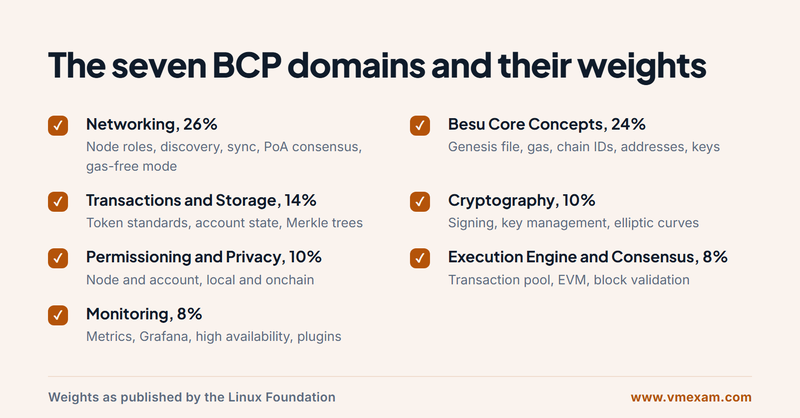
The syllabus has seven domains with published weights. Two of them, Networking at 26% and Besu Core Concepts at 24%, make up half the exam, so they deserve the most study time. The other five range from 14% down to 8%.
Besu Core Concepts (24%)
This domain checks the Ethereum fundamentals that every Besu operator relies on. Its competencies are blockchain propagation, the genesis file, gas, logs and events, hashing, encryption and signing, public networks and chain IDs, Ethereum addresses, the blockchain trilemma, nodes and public keys.
The genesis file is central. It defines the first block of a network and its configuration, including the chain ID, the consensus mechanism and its settings, the block gas limit and any accounts funded at the start. A mistake here affects every node, which is why questions often ask what a given field controls. The chain ID matters because it separates networks and is included in transaction signatures, so a transaction signed for one chain cannot be replayed on another.
Gas is the unit that measures computation. Every transaction pays for the gas it uses, and each block has a gas limit that caps the work it can contain. Logs and events are how smart contracts report what happened; they are recorded with transaction receipts and are what applications listen to. An Ethereum address is derived from the public key by hashing it and keeping the last 20 bytes, which links the address topic to the public key and hashing topics in the same domain.
The blockchain trilemma describes the trade-off between decentralisation, security and scalability. It is useful exam context for explaining why private networks often choose a small set of known validators: they give up some decentralisation for throughput and fast finality.
Networking (26%)
Networking is the largest domain, with ten competencies: RPC nodes, validator nodes, adding a new node, the full synchronisation method, node discovery, networking fundamentals, proof of authority consensus, trusted private networks, gas-free mode and a comparison of consensus mechanisms.
Node roles come first. Validator nodes propose and validate blocks in a proof of authority network. RPC nodes serve application requests through the JSON-RPC interface and should be kept separate from validators so that application load cannot disturb block production. Adding a node involves giving it the same genesis file, letting it find peers and letting it synchronise the chain. Full synchronisation downloads and executes every block from the start, which is slow but verifies everything locally.
Node discovery is how peers find each other. Bootnodes act as the first contact points, static nodes are configured explicitly, and discovery protocols spread knowledge of peers through the network. In a trusted private network, discovery is often restricted so that only approved nodes can connect.
Consensus is the topic most likely to decide your score in this domain. Besu supports several proof of authority mechanisms for private networks, including QBFT, IBFT 2.0 and Clique. QBFT and IBFT 2.0 are Byzantine fault tolerant protocols that give immediate finality: once a block is added it is not reversed, and the network keeps producing blocks as long as more than two thirds of validators are honest and online. Clique is simpler and tolerates more validators going offline but does not provide immediate finality. Gas-free mode lets a private network set the gas price to zero, so participants do not need to hold a currency to transact, while gas still limits how much work a block can contain.
Transactions and Storage (14%)
This domain covers token standards, the roles of a blockchain node, account state, Merkle trees, account storage and the Ethereum world state. Token standards such as ERC-20 for fungible tokens, ERC-721 for non-fungible tokens and ERC-1155 for mixed collections define the functions and events a contract must provide.
Each account has a state made up of its nonce, balance, storage root and code hash. Contract data lives in account storage, and all account states together form the world state. Ethereum organises this data in Merkle Patricia tries, so a single root hash summarises the whole state and any change produces a new root. Understanding this structure explains why nodes can verify data efficiently and why storage format choices affect disk use and performance.
Cryptography (10%)
Cryptography covers transaction signing mechanisms, private key management, symmetric and asymmetric encryption, structured data signing and elliptic curve cryptography. Ethereum signs transactions with ECDSA on the secp256k1 curve, and the signature lets any node recover the sender's address without the private key ever leaving its owner.
Structured data signing, defined in EIP-712, lets users sign readable typed data rather than an opaque string, which reduces the risk of signing something misleading. Key management questions test good practice: protecting node and account keys, separating validator keys from other credentials and never storing keys in places such as shared repositories.
Permissioning and Privacy (10%)
Permissioning controls who can join and act on a network. Node permissioning decides which nodes may connect to each other, typically through an allowlist of node identities. Account permissioning decides which accounts may submit transactions or deploy contracts. Both can be configured locally on each node through configuration files, or onchain through smart contracts that all nodes consult, which keeps rules consistent across the network.
Privacy in blockchain addresses the fact that every node normally sees every transaction. The exam expects you to know the use cases for privacy, such as competitors sharing a network, and the general approaches to keeping some data visible only to its participants. Because Besu's privacy features have changed between releases, check the current documentation for the version you study.
Execution Engine and Consensus (8%)
This domain covers the transaction pool, EVM architecture, block validation and the layered transaction pool. The transaction pool holds pending transactions until they are included in a block; Besu's layered pool organises them so that transactions ready to run are separated from those waiting on an earlier nonce, which improves block building and resistance to spam.
The Ethereum Virtual Machine is a stack-based machine that runs contract bytecode, charging gas for each operation. Block validation means checking that a block's header, transactions and resulting state are correct before accepting it, which is what keeps every node in agreement.
Monitoring (8%)
Monitoring covers Besu node monitoring, high availability, monitoring with Grafana and plugins. Besu exposes metrics that can be collected by Prometheus and displayed in Grafana dashboards, showing block height, peer count, transaction pool size and resource use. High availability means designing so that losing one node does not stop the service, for example by running several RPC nodes behind a load balancer and enough validators to keep consensus. Plugins extend Besu with custom behaviour through its plugin interface.
How do public and private Besu networks differ?
Many BCP questions turn on whether a scenario describes a public or a private network, because the right answer for one is often wrong for the other. Keeping the main differences clear saves time across several domains.
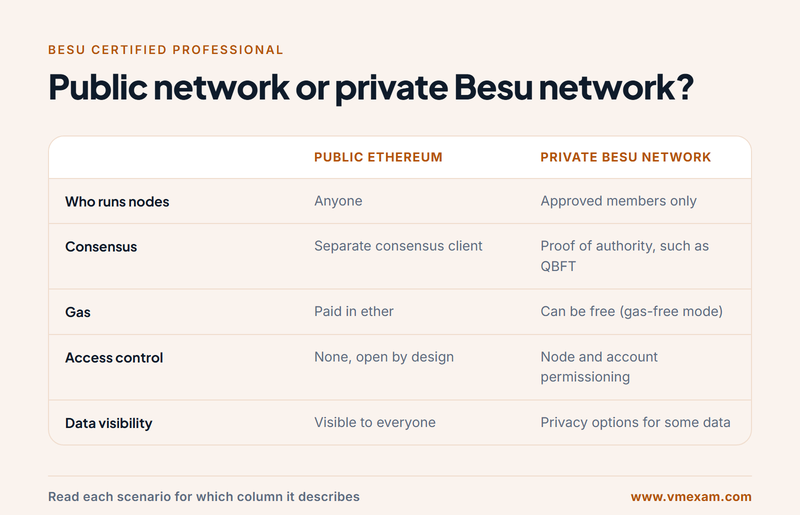
On the public Ethereum network, Besu runs as an execution client alongside a separate consensus client, and anyone can run a node. Transactions pay gas in ether, all data is visible to everyone, and the chain ID identifies the public network. Permissioning does not apply, because the network is open by design.
A private Besu network is defined by its own genesis file and chain ID. Consensus usually uses proof of authority, such as QBFT, with a known set of validators. Gas can be free, node and account permissioning restrict who takes part, and privacy features can limit who sees particular transactions. The operator is responsible for everything a public network gets from its community: validator availability, monitoring, upgrades and recovery.
When a question gives a requirement such as "only member organisations may run nodes" or "transactions must be final as soon as they are included", map it to the private network column. Membership points to permissioning; immediate finality points to QBFT or IBFT 2.0 rather than Clique.
Which BCP domain is hardest for candidates?
For most candidates, Networking is the hardest domain as well as the largest. It mixes peer-to-peer concepts, node roles, synchronisation and several consensus mechanisms, and its questions are usually scenarios rather than definitions.
Developers who come from smart contract work often know Core Concepts and Transactions and Storage well, because those topics appear in Solidity tutorials. What they rarely have is experience running several nodes, watching them discover each other and seeing what happens when a validator goes offline. Infrastructure engineers have the opposite problem: they are comfortable with networking and monitoring but less sure of Ethereum's state model and cryptography.
The fix for both groups is a small private network of four nodes on one machine. Create a genesis file for QBFT, start the nodes, stop one validator and watch blocks continue, then stop a second and watch them halt. Add a fifth node and follow it through discovery and synchronisation. Enable metrics and connect Grafana. A weekend of this turns the Networking and Monitoring domains from memorisation into experience.
Does the Linux Foundation offer an official BCP practice test or question bank?
The Linux Foundation points candidates to free learning material, including its Besu Essentials: Creating a Private Blockchain Network course (LFS176x), along with the candidate handbook and exam FAQs on its BCP page. That page is where to look for anything new, because material from the foundation itself is the only kind that carries its authority.
The VMExam BCP practice test comes from us, not from the Linux Foundation. It provides timed, multiple-choice questions written against the seven published domains, with an explanation for each answer. Use the foundation's course and your own test network to learn Besu, and use timed practice questions to confirm that you can answer accurately within 90 seconds per question.
Stay away from sellers of leaked exam content. The Linux Foundation's Global Certification and Confidentiality Agreement forbids it, a breach can cost you the certification, and reworded scenarios defeat memorised answers anyway.
How should you prepare for BCP in six weeks?
This plan assumes basic familiarity with Linux, the command line and blockchain ideas, and six to eight hours of study a week. Time is split in proportion to the published weights, which is why Networking alone gets two weeks.
- Week 1: Besu Core Concepts. Genesis file fields, chain IDs, gas, logs and events, addresses and keys. Read a real genesis file line by line.
- Week 2: Networking, part one. Build a four-node QBFT network, add bootnodes and static nodes, and follow a new node through discovery and full synchronisation.
- Week 3: Networking, part two. Compare QBFT, IBFT 2.0 and Clique, test validator failures, separate RPC nodes from validators and try gas-free mode.
- Week 4: Transactions and Storage, and Cryptography. Account state, world state and Merkle Patricia tries, token standards, transaction signing, EIP-712 and key management.
- Week 5: Permissioning and Privacy, Execution Engine and Consensus, and Monitoring. Configure node and account permissioning, study the transaction pool and EVM, and set up Prometheus and Grafana.
- Week 6: full timed practice tests, review of every wrong answer by domain, and a final pass over consensus and genesis configuration.
A week before your booking, go through the candidate handbook for Linux Foundation exams. It explains the ID check, how your desk and room must look, and what the proctor will and will not allow.
Mistakes BCP candidates often make
- Studying smart contracts in depth while spending too little time on Networking, the largest domain at 26%.
- Mixing up node permissioning and account permissioning, or local and onchain permissioning.
- Assuming every proof of authority mechanism gives immediate finality, when Clique does not.
- Running RPC traffic on validator nodes in design scenarios, which puts block production at risk.
- Forgetting that gas still limits block contents in a gas-free network.
- Reading about Besu without ever running it, so configuration and log questions become guesses.
Book the exam once your practice scores sit comfortably above 75% with time to spare, and use the included retake only if you need it. With 12 months of eligibility from purchase, there is no reason to sit the exam before your test network and your scores say you are ready.
FAQs
How many questions are on the BCP exam and how long is it?
You get 90 minutes for 60 questions on the BCP exam, which leaves about 90 seconds for each question. That is tight for scenario items on consensus or permissioning, so practise under a timer and get used to deciding quickly which domain a question is really testing.
What is the passing score for the Besu Certified Professional exam?
You need 75% to pass, which means roughly 45 of the 60 questions answered correctly. With so little margin, a weak domain can decide the result. Aim for practice scores that sit clearly above 75% across all seven domains before you schedule the real exam.
How much does the BCP exam cost?
Buying the BCP exam on its own costs USD 250 at October 2026 prices. A bundle at USD 495 pairs the exam with a year of the THRIVE-ONE subscription, which opens the foundation's wider training catalogue. Offers change during the year, so check the amount shown when you pay.
Does the BCP exam include a retake?
Yes. The Linux Foundation includes two exam attempts with each purchase, so one retake is covered, and both must be used within a year of buying. Treat the retake as insurance against a bad day or a connection problem rather than as part of your study plan.
How long does the Besu Certified Professional certification last?
A BCP pass stays current for two years, according to the Linux Foundation. Once that period ends, keeping the credential means certifying again. Put the end date in your calendar on the day your badge arrives, and show the badge on LinkedIn, LFX or GitHub while it is valid.
Is the VMExam BCP practice test Linux Foundation material?
No. Our BCP practice test is independent and is not produced or endorsed by the Linux Foundation. It uses timed questions mapped to the seven published domains, with explanations. The foundation's own learning option includes its free Besu Essentials course, LFS176x.
- Linux Foundation Blockchain Certification |
- BCP Besu Professional |
- BCP Mock Test |
- BCP Practice Exam |
- BCP Prep Guide |
- BCP Questions |
- BCP Simulation Questions |
- BCP |
- Besu Certified Professional (BCP) Questions and Answers |
- Besu Professional Online Test |
- Besu Professional Mock Test |
- Linux Foundation BCP Study Guide |
- Linux Foundation Besu Professional Exam Questions |
- Linux Foundation Besu Professional Cert Guide |
- Besu Professional Certification Mock Test |
- Besu Professional Simulator |
- Besu Professional Mock Exam |
- Linux Foundation Besu Professional Questions |
- Besu Professional |
- Linux Foundation Besu Professional Practice Test |
- BCP Books |
- BCP Exam Cost |
- BCP Passing Score |
- BCP Syllabus |
- Besu Professional Exam Books |
- Besu Certified Professional (BCP) |
- Besu Professional Certification Syllabus |
- Besu Professional Exam Prep Guide |
- Besu Professional Exam Price |
- Besu Professional Study Guide |
- Besu Professional Training |
- Linux Foundation Besu Professional Training |
- Besu Professional Certification Cost


