
Claude Certified Associate Skills Partner Teams Use at Work

A Claude Certified Associate is someone at a partner organisation who can guide customers to the right Claude use cases and make those deployments work: writing clear prompts, checking outputs for accuracy, choosing the right product and model, configuring Projects, fitting Claude into real workflows and keeping its use responsible.
Anthropic validates these skills with the Claude Certified Associate - Foundations exam, code CCAO-F. Rather than restating the exam page, this article walks through the work itself: what consultants, sellers and delivery leads actually do with Claude on a customer engagement, why each skill matters, and how each one maps to the seven published exam domains. It also answers the question most readers arrive with, which is who is allowed to sit the exam.
What does a Claude Certified Associate actually do at work?
Anthropic describes the Associate track as being for consultants, sellers and delivery leads who guide customers toward the right Claude use cases and set engagements up for success. In practice that is a hybrid role. It sits between the business stakeholder who wants results and the technical team that may later build integrations, and its value lies in judgement about where Claude helps, how to ask it well and how to tell whether its work is good enough to use.
A typical week on a customer engagement might include a discovery session where a finance team describes a slow month-end reporting process, followed by a short proof of concept in which the associate drafts prompts that summarise variance commentary from spreadsheets. Midweek brings a review of what Claude produced, with a list of errors to correct and a decision about where human sign-off must stay. By Friday the associate may be setting up a shared Project with instructions and reference documents so the finance team can repeat the task without help.
None of this requires writing code. It requires a working understanding of how Claude behaves, where it is strong, where it can go wrong and how to set it up so that a team of non-specialists gets consistent results. That is the ground the Foundations exam covers, and it explains why the credential suits client-facing staff rather than only engineers.
How do strong prompts and task decomposition change the results?
The quality of Claude's output depends heavily on the quality of the request. A strong business prompt states the goal, the audience, the material to work from, the constraints and the format of the answer. "Summarise this contract" invites a generic summary. "Summarise the termination, liability and renewal clauses of this supplier contract for a procurement manager, in a table with clause, plain-English meaning and risk level" produces something a person can act on.
Task decomposition is the next step up. Complex requests work better when they are split into stages: first extract the facts, then analyse them, then draft the deliverable. Each stage can be checked before the next begins, which makes errors easier to find and keeps Claude focused. Associates also adapt their approach to the type of task, because analysis, research, drafting and brainstorming each benefit from different instructions. Brainstorming rewards breadth and permission to be speculative; analysis rewards precise source material and an explicit request to show reasoning.
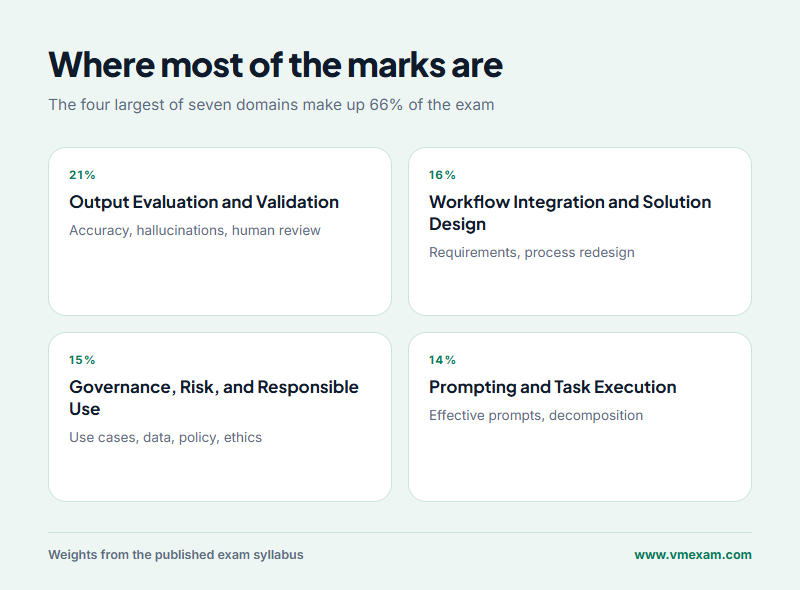
Iteration is the third habit. A first prompt rarely gives the best result, so associates refine instructions based on what came back, add examples of the desired output, or ask Claude to critique and improve its own draft. In the exam, the Prompting and Task Execution domain accounts for 14% and covers creating effective prompts for business and technical tasks, structuring complex requests, iterating to improve quality and adapting strategy by task type.
Why is output evaluation the most heavily weighted skill?
Output Evaluation and Validation carries 21% of the exam, more than any other domain, and the reason is simple: an AI deployment is only as trustworthy as the checks around it. Claude can produce fluent, confident text that contains errors, so the most valuable skill an associate brings to a customer is knowing how to verify what it produced before anyone relies on it.
Evaluation starts with accuracy and completeness. Does the summary reflect every important point in the source, and does each claim trace back to something real? Associates learn to spot hallucinations, meaning confident statements that are not supported by the source or by fact, as well as internal inconsistencies, such as a total that does not match its parts, and signs of bias in tone or framing. Practical techniques include asking Claude to quote the passages it relied on, cross-checking figures against the original documents and comparing two independent drafts.
Just as important is knowing when human review cannot be skipped. Legal advice, financial figures headed for a board, medical information and anything customer-facing usually need a qualified person to approve them. The domain also covers editing and adapting output for its audience, and choosing the right format, whether an artifact, an inline answer or structured data. An associate who sets those review points up at the start of an engagement protects both the customer and the partner's reputation. Together with workflow integration, governance and prompting, evaluation is one of four domains that make up 66% of the exam.
How do you choose between Claude products and models?
Customers often assume there is one Claude, so part of the associate's role is explaining the options. On the product side, chat suits quick questions and drafting, Projects keep instructions and reference material together for repeated work, research mode supports deeper investigation across sources, and artifacts give a separate, reusable space for documents, code or visuals produced in a conversation.
On the model side, Anthropic offers the Haiku, Sonnet and Opus families, which trade off speed, cost and capability. Haiku models suit fast, high-volume and simpler tasks; Sonnet models balance quality and speed for most everyday work; Opus models are aimed at the most demanding reasoning. A good associate matches the model to the job rather than defaulting to the largest one, and can explain that choice to a customer in terms of cost, response time and quality.
Context is the third consideration. Every conversation has a finite context window, and very long threads can lose focus or carry outdated assumptions. Associates know when to start a fresh conversation, when to ask Claude to summarise progress before continuing, and when to move stable material into a Project so it persists. The Product and Model Selection domain is worth 12% of the exam and covers exactly these decisions.
How are Projects, instructions and connectors set up for a team?
Configuration is what turns a one-off success into something a whole team can repeat. A well-built Project combines clear system-level instructions, describing the role Claude should play, the standards to follow and the format to use, with a curated set of knowledge sources such as policy documents, templates and examples of good past work.
Connectors extend this by letting Claude draw on tools a team already uses; the exam objectives give Google Drive and Gmail as examples. Associates decide which sources a Project really needs, because more material is not always better: outdated or conflicting documents lead to confused answers. They also plan for maintenance, since instructions and knowledge sources need updating as policies, products and prices change.
A practical pattern is to treat each Project like a small product. It has an owner, a short description of its purpose, a list of approved sources with dates, and a review cycle. When answers start to drift, the owner checks whether the instructions or the documents have gone stale before blaming the model. Configuration and Knowledge Management accounts for 12% of the exam and covers configuring Projects, managing uploaded knowledge and connectors, writing effective instructions and keeping configurations current.
Where does Claude fit into existing workflows, and what happens when it underperforms?
The biggest gains rarely come from asking Claude isolated questions. They come from placing it inside a process the customer already runs. Associates start by analysing requirements: who does the work today, where time is lost, which steps involve reading, writing or summarising, and which need judgement or approval. Claude can then support research, planning, solution design and iteration, either augmenting existing steps or redesigning the process around them.
Communicating value and limits is part of the same job. Stakeholders need a realistic picture: Claude can cut the time spent on a first draft dramatically, but it does not remove the need for expertise, and it will not know internal facts it has not been given. Setting expectations early prevents the disappointment that follows overselling. The Workflow Integration and Solution Design domain is worth 16% of the exam.
When results disappoint, associates troubleshoot systematically rather than giving up. Is the prompt ambiguous? Is key context missing? Is the task too large for one request? Is the wrong model or product being used? Changing one variable at a time and comparing outputs usually reveals the cause. They also optimise working processes once they run well, removing unnecessary steps and saving reusable prompts. Troubleshooting and Optimization is the smallest domain at 10%, but its methods apply to every other domain.
A worked example: a sales proposal workflow
Consider a professional services firm that wants faster proposal writing. The associate maps the current process and finds that consultants spend hours rewriting standard sections and searching past proposals. The redesign uses a Project containing approved service descriptions, case studies and the firm's style guide, with instructions telling Claude to draft only from those sources and to flag any requirement it cannot answer.
The workflow is decomposed into stages: Claude first extracts the client's requirements from the request for proposal into a checklist, then drafts each section against that checklist, and finally produces a compliance table showing which requirement each section answers. A consultant reviews every pricing statement and every client-specific claim before sending. When early drafts sound too generic, the associate troubleshoots, adds two strong past proposals as examples and tightens the instructions, and the next drafts improve. Every domain of the syllabus appears in this one engagement.
What does responsible use of Claude look like in a client engagement?
Governance is where an associate's advice carries the most weight. The first question is whether a use case is appropriate at all. Drafting internal documents, summarising research and preparing first-pass analysis are usually sound. Making final decisions about people, such as hiring or credit, or giving regulated advice without qualified review, needs much more caution or should be avoided.
Data sensitivity is the second question. Associates help customers decide what information may be shared with Claude, considering personal data, confidential commercial material and any sector regulations that apply. They make sure the organisation's own AI policies are followed, that people know what they may and may not upload, and that outputs carry appropriate review before use.
The ethical dimension completes the picture: being transparent with end users when AI has contributed to a deliverable, watching for biased outputs, and keeping humans accountable for decisions. Governance, Risk, and Responsible Use carries 15% of the exam and covers appropriate and inappropriate use cases, data sensitivity and privacy, organisational AI policies and the ethical implications of AI use.
Who can take the Claude Certified Associate exam, and how is it run?
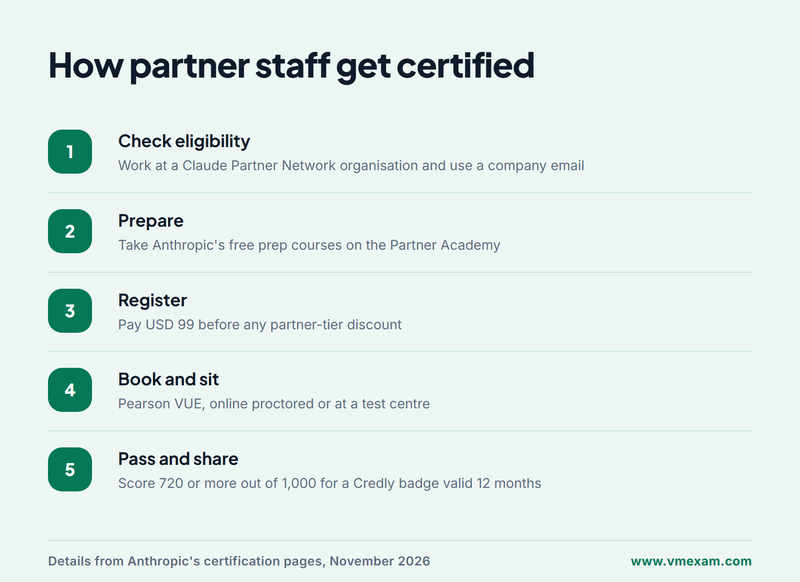
Eligibility is the first thing to check. According to Anthropic's certification eligibility page, Claude certification exams are open to people who work at organisations in the Claude Partner Network. Registration requires a company email on a domain listed in the organisation's partner record, so a personal address will not work, and candidates must be at least 18 with a government-issued ID. People outside the network can study through Claude Academy, Anthropic's public course platform, whose courses end with a quiz and a certificate of completion; that certificate is a different thing from the proctored certification.
The exam itself has 60 questions and a 120-minute time limit. It is scored on a scale of 100 to 1,000, and a scaled score of 720 is required to pass. The price is USD 99 before any partner-tier discount, as of November 2026. After payment, Anthropic emails a Pearson VUE link to book the exam, either online with a remote proctor or at a test centre. A pass earns a Credly badge, and the credential is valid for 12 months.
| Exam detail | Value |
|---|---|
| Certification | Claude Certified Associate - Foundations |
| Exam code | CCAO-F |
| Number of questions | 60 |
| Time limit | 120 minutes |
| Passing score | Scaled score of 720 on a scale of 100 to 1,000 |
| Price | USD 99 before partner-tier discount, November 2026 |
| Delivery | Pearson VUE, online proctored or test centre |
One point surprises many candidates: the Associate credential does not count towards a firm's Claude Partner Network tier eligibility, according to Anthropic's certification FAQ. The Developer and Architect certifications do. The Associate exam is therefore best seen as proof of individual skill for client-facing staff rather than as a lever for the firm's partner tier.
The seven domains and their weights, as listed in the Claude Associate Foundations syllabus, show where study time should go.
| Exam domain | Weight |
|---|---|
| Prompting and Task Execution | 14% |
| Output Evaluation and Validation | 21% |
| Product and Model Selection | 12% |
| Workflow Integration and Solution Design | 16% |
| Configuration and Knowledge Management | 12% |
| Governance, Risk, and Responsible Use | 15% |
| Troubleshooting and Optimization | 10% |
What preparation material does Anthropic provide?
Anthropic publishes an exam guide and free prep courses for each certification on its Partner Academy, and the Claude Certified Associate - Foundations certification page links to the guide, the courses and registration. Those courses are the primary way to learn the material. Our practice test is third-party material with no Anthropic involvement: it gives you scenario questions under a timer, sorted into the seven domains, and explains the reasoning behind every answer so you can test your judgement before booking.
A four-week plan for busy client-facing staff
In week one, complete Anthropic's prep courses and work through prompting and output evaluation together, since they reinforce each other: write prompts for real tasks from your own job, then check every output against its source. Week two covers product and model selection and configuration. Build a Project for a recurring task, write its instructions, attach a small set of knowledge sources and test it with a colleague.
Week three is for workflow integration, troubleshooting and governance. Map one real process, decide where Claude fits and where human review stays, and write a short note on which data may and may not be used. In week four, take timed practice under exam conditions, 60 questions in 120 minutes, and review every incorrect answer against Anthropic's guidance before booking the exam.
Where candidates commonly slip
Many people treat the exam as a test of prompt tricks. Questions focus on judgement: which product fits, when to stop and verify, what must not be shared. Another frequent gap is underestimating output evaluation, even though it is the largest domain. Candidates also overlook governance scenarios, assuming common sense will be enough, when the questions expect a clear grasp of data sensitivity, organisational policy and appropriate use. Finally, many people forget that the credential lasts 12 months, so plan for recertification from the start.
FAQs
Who is eligible to take the Claude Certified Associate - Foundations exam?
Only people who work at organisations in the Claude Partner Network can register. You need a company email on a domain in your organisation's partner record, and you must be 18 or older with a government-issued ID. People outside the network can learn through Claude Academy instead.
How many questions are on the Claude Certified Associate exam?
There are 60 questions with a 120-minute time limit, which allows about two minutes per question. Many items describe a customer scenario and ask for the best judgement, so practise reading carefully and deciding which domain, such as evaluation or governance, the question is really testing.
What score do you need to pass the Claude Certified Associate exam?
Results are reported as a scaled score between 100 and 1,000, and the pass mark is 720. Because the score is scaled, it is not a simple percentage of correct answers, so aim for strong practice results across all seven domains.
How much does the Claude Certified Associate exam cost?
The exam costs USD 99 before any partner-tier discount, as of November 2026. You pay through Anthropic's Partner Academy, and Anthropic then sends a Pearson VUE link so you can book an online proctored session or a test centre appointment.
How long is the Claude Certified Associate credential valid?
Anthropic states that its certifications are valid for 12 months, and a pass also earns a Credly badge you can share. Because the validity period is short, note your expiry date when the badge arrives and plan recertification well before it lapses.
Is the VMExam practice test made by Anthropic?
No. It is third-party material written by VMExam without any Anthropic involvement. You answer scenario questions under a timer, sorted into the seven syllabus domains, and each one explains why the right answer is right. Anthropic's own exam guide and free prep courses on its Partner Academy remain the primary study material.
- Anthropic CCAO-F Syllabus |
- Anthropic CCAO-F Exam Summary |
- CCAO-F Exam Objectives |
- CCAO-F Exam Topics |
- Claude Associate Foundations Certification Syllabus |
- CCAO-F Exam Cost |
- Claude Associate Foundations Certification Cost |
- CCAO-F Exam Duration |
- CCAO-F Passing Score |
- CCAO-F Exam Registration |
- Claude Associate Foundations Training |
- Anthropic Claude Associate Foundations Books |
- Anthropic Claude Associate Foundations Study Guide |
- Anthropic Claude Certified Associate - Foundations (CCAO-F) Exam Guide |
- Anthropic CCAO-F Sample Questions |
- CCAO-F Sample Questions and Answers |
- CCAO-F Free Practice Questions |
- CCAO-F Question Format |
- CCAO-F Demo Exam |
- Claude Associate Foundations Certification Sample Questions |
- Claude Associate Foundations Sample Test |
- Anthropic Claude Certified Associate - Foundations (CCAO-F) Questions and Answers |
- Anthropic Claude Associate Foundations Exam Questions


