
Marketing Cloud Engagement: Trends Shaping the Future of Email

Salesforce Marketing Cloud Engagement is moving from a toolset where marketers build every email and journey by hand towards an agentic platform where AI agents draft, segment and optimise under human direction. Unified customer data, stricter inbox rules and privacy-driven measurement are reshaping the specialist's job at the same time.
For practitioners, the credential that proves command of today's platform is the Salesforce Certified Marketing Cloud Engagement Specialist. This article looks ahead rather than back. It sets out the forces changing email and cross-channel marketing over the next few years, explains what each one means for the people who run Marketing Cloud day to day, and shows why the fundamentals in the specialist syllabus are becoming more valuable, not less, as automation spreads.
Where is Marketing Cloud Engagement heading next?
The clearest signal comes from Salesforce itself. Its agentic marketing page now describes Marketing Cloud Next as "an agentic marketing platform for the entire customer lifecycle", natively built on Salesforce's core platform. In plain terms, the company is betting that the next generation of marketing work will be done by AI agents that plan, build and adjust campaigns, with marketers setting goals, guardrails and brand standards.
That does not mean the familiar product is disappearing. Salesforce's own FAQ explains that Marketing Cloud is the umbrella brand for all of its marketing products, new and classic, and names Marketing Cloud Engagement, formerly ExactTarget, alongside Marketing Cloud Account Engagement, formerly Pardot. The same FAQ says that every Marketing Cloud customer is a Marketing Cloud Next customer. The practical reading is evolution rather than replacement: the agentic layer is arriving on top of, and next to, the email, journey and data tools that thousands of teams already run.
For a specialist, this shapes career strategy. The organisations that adopt agentic features first will be those whose Engagement accounts are already clean: well-modelled data extensions, reliable automations, documented journeys and a healthy sending reputation. An agent can only act on the data and assets it is given, so the people who understand how those foundations work will be the ones trusted to switch the new capabilities on.
How will AI agents change the email specialist's daily work?
Salesforce describes Agentforce for Marketing Cloud as a set of pre-built skills that streamline key marketing tasks. Read across the industry, the direction is consistent: agents that turn a campaign brief into a draft journey, propose audience segments, write subject line and body variants, and recommend changes once results arrive. The repetitive assembly work that once filled a specialist's week is the first candidate for automation.
What remains, and grows, is judgement. Someone still has to decide whether a proposed segment respects consent, whether a generated subject line fits the brand and the law in each market, whether a journey's wait steps make sense for the buying cycle, and whether a reported uplift is real or an artefact of measurement. Those decisions draw directly on the knowledge the specialist exam tests: email best practice, send settings, preference management and analytics.
A useful way to picture the shift is from builder to editor and operator. The specialist of the past assembled every content block and decision split. The specialist of the near future briefs an agent, reviews what it produces, corrects the parts that are wrong, approves the send and audits the outcome. That role needs a firmer grasp of how the platform behaves, because reviewing a journey you did not build is harder than building one yourself.
There is also a governance dimension that many teams underestimate. Generated content needs an approval path, a record of who signed off, and rules about which data an agent may use for personalisation. Marketers who can design those controls inside Marketing Cloud, using roles, business units, approval steps and test sends, will be in a strong position as legal and brand teams start asking how AI-written emails are checked before they reach customers.
Why does unified customer data matter more every year?
Every agentic promise rests on data. Salesforce now calls its data platform Data 360, which its own site describes as the new name for what was previously Data Cloud. The idea behind it is a single, continuously updated view of each customer drawn from sales, service, commerce, web and marketing systems, so that every channel, human or automated, acts on the same picture.
Inside Marketing Cloud Engagement, the equivalent discipline already exists and carries real weight in the exam. The Subscriber and Data Management domain covers setting up data extensions, importing data, configuring segmentation and troubleshooting send discrepancies caused by subscriber preferences. Those tasks look modest next to a customer data platform, but they are the same skills at smaller scale: choosing a primary key, deciding which fields are sendable, relating tables correctly and keeping consent status accurate.
The strategic point is that poor data is amplified by automation. A mistake in a sendable relationship once caused one bad send; in an agent-driven programme it can feed every segment the agent builds. Teams that treat data modelling as a core marketing competency, rather than an IT afterthought, will move faster and more safely as unified profiles and real-time triggers become normal. Specialists who can explain why a contact did not receive an email, by tracing it through All Subscribers status, publication lists and data extension filters, are already doing the diagnostic work that tomorrow's platforms will demand at greater volume.
Is deliverability now the first test of every email programme?
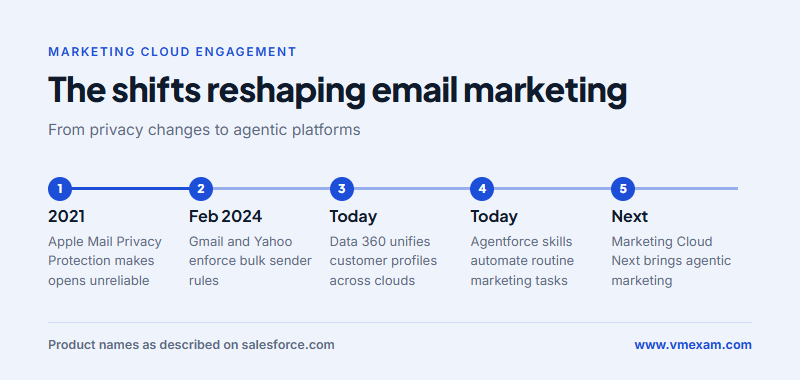
Deliverability has moved from a technical concern to a business gate. In February 2024, Google and Yahoo began enforcing new requirements for bulk senders. Google's sender guidelines require senders of more than 5,000 messages a day to Gmail accounts to set up SPF, DKIM and DMARC authentication, to support one-click unsubscribe for marketing messages, and to keep spam rates reported in Postmaster Tools below 0.30%, with a recommended target of 0.10%. Yahoo's published standards require SPF, DKIM and a valid DMARC policy, one-click unsubscribe honoured within two days, and a spam rate below 0.3%.
The effect is that a programme can be well designed and still fail if authentication is incomplete or complaints creep up. For Marketing Cloud teams, this puts weight on setup work that is easy to neglect: a properly authenticated sender domain, a consistent from address, list-unsubscribe headers, and permission-based list growth. It also changes how success is judged. Sending more email to less engaged contacts now carries a visible penalty in inbox placement.
The exam's Email Marketing Best Practices domain addresses exactly this territory. It asks candidates to distinguish the elements of an email that affect deliverability and to apply sound acquisition and retention methods. Although the domain is the smallest at 10% of the exam, its subject matter now influences every other domain, because content, automation and analytics all depend on the message reaching the inbox in the first place.
Looking ahead, expect mailbox providers to keep raising the bar rather than relaxing it. Engagement-based filtering, stricter handling of unauthenticated mail and closer scrutiny of complaint rates are the direction of travel. Specialists who build sunset policies for inactive subscribers, monitor complaint and bounce trends, and design preference centres that let people reduce frequency instead of leaving entirely will protect their sender reputation as standards tighten.
How are privacy changes reshaping email measurement?
Since Apple introduced Mail Privacy Protection in 2021, open rates have become an unreliable signal. The feature preloads remote content, including tracking pixels, for many Apple Mail users, so an email can register as opened whether or not anyone read it. Any reporting, automation or send-time logic that relies heavily on opens has had to be rethought.
The forward-looking response is to measure closer to business value. Clicks, conversions, revenue per send, unsubscribe and complaint rates, and downstream behaviour tracked in the customer's journey tell a more honest story than opens. Marketing Cloud's own tools support this when they are configured well: tracking reports, Journey Builder goal and exit criteria, and the Einstein capabilities that score engagement and suggest timing based on broader behaviour.
The Insights and Analytics domain, worth 14% of the exam, reflects the same priority. Candidates must explain the metrics available for email campaigns and what each one means, describe how to analyse campaign performance, configure ad hoc and automated reports, and recommend an Einstein product that analyses campaign effectiveness. Einstein features such as Engagement Scoring, Send Time Optimization, Engagement Frequency and Copy Insights are examples of where the platform is already blending prediction with reporting.
As agents take on more optimisation, the analyst's role becomes more important rather than less. Someone has to decide which metric an agent should optimise for, notice when it is chasing a misleading signal, and explain results to leadership. A specialist who understands why an open rate jumped after an Apple update, or why a send-time model needs enough history to be useful, will be the person who keeps automated optimisation honest.
Why are journeys replacing one-off campaigns?
Customers now expect messages that respond to what they just did: a welcome series that adapts to the first purchase, a reminder triggered by an abandoned cart, a service update sent the moment a case is closed. That expectation is pushing teams away from scheduled batch campaigns towards event-driven journeys that run continuously and adjust to each person's behaviour.
In Marketing Cloud Engagement, the two pillars of this work are Journey Builder and Automation Studio. Journey Builder orchestrates the customer-facing path: entry sources, decision splits, wait periods, engagement splits and exit criteria. Automation Studio handles the data operations that keep journeys fed: imports, SQL query activities, filters, file transfers and scheduled refreshes. The Marketing Automation domain, at 26%, asks candidates to recommend the right automation solution for a scenario and to build both kinds of solution.
The future version of this work involves more real-time inputs and more automated decisioning, but the design questions stay the same. Which event should start the journey? How should a contact who already converted leave it? What happens when two journeys want to message the same person on the same day? Specialists who think in terms of lifecycle stages rather than individual sends will design programmes that agents can extend without creating conflicts or message fatigue.
Content follows the same pattern. The Content Creation and Delivery domain, worth 24%, covers choosing the right tools to prepare an email for sending, customising messages, configuring send settings and organising campaign content. As generative tools produce more variants, the value moves to structure: reusable content blocks, dynamic content rules, personalisation strings and AMPscript where it is warranted, plus a content library organised well enough that people and agents can find and reuse approved assets.
Which skills will keep Marketing Cloud specialists in demand?
The most durable skill set combines marketing judgement with platform fluency. Strategy alone cannot diagnose why a journey stalled, and technical skill alone cannot decide which customers should receive which message. The specialists who stay in demand as agentic tools mature will be those who can work across both sides, translating business goals into data models, journeys and measurement plans that both humans and agents can execute.
Five capabilities stand out. The first is data literacy: modelling data extensions, writing segmentation logic and tracing send discrepancies. The second is deliverability stewardship: authentication, list hygiene and complaint management. The third is lifecycle design: journeys with clear entry, goals and exits. The fourth is measurement discipline: choosing metrics that reflect value and interpreting Einstein output critically. The fifth is AI governance: review, approval and consent controls for generated content and automated decisions.
Salesforce validates the platform side of that skill set with the Marketing Cloud Engagement Specialist certification. The exam has 65 questions to answer in 90 minutes, and the passing score is 67%. Registration costs USD 200 and a retake costs USD 100 as of November 2026, and exams are scheduled through Kryterion Webassessor or Pearson VUE.
| Exam detail | Value |
|---|---|
| Certification | Salesforce Certified Marketing Cloud Engagement Specialist |
| Exam code | MC-202 |
| Number of questions | 65 |
| Duration | 90 minutes |
| Passing score | 67% |
| Registration fee | USD 200 as of November 2026 |
| Retake fee | USD 100 as of November 2026 |
The five exam sections and their weights show where the certification places its emphasis. Marketing automation and subscriber and data management carry the most weight, together accounting for more than half of the exam, which matches the argument of this article: data and orchestration are the foundations everything else depends on. The complete objectives are listed in the Marketing Cloud Engagement Specialist syllabus.
| Exam section | Weight |
|---|---|
| Email Marketing Best Practices | 10% |
| Content Creation and Delivery | 24% |
| Marketing Automation | 26% |
| Subscriber and Data Management | 26% |
| Insights and Analytics | 14% |
How should you prepare for the specialist exam while the platform evolves?
Study the platform as it is examined today, and read about the agentic direction as context. The exam tests current Marketing Cloud Engagement capabilities through scenario questions, so time spent in a working account, building data extensions, journeys, automations and reports, is worth more than time spent reading launch announcements. Salesforce's Trailhead credential page is the place to confirm the current exam guide and recommended learning before you book.
Does Salesforce offer an official practice exam for this credential?
Salesforce points candidates to Trailhead for preparation, including trailmixes and modules aligned to the credential, and our syllabus page lists Salesforce's instructor-led course Build and Analyze Customer Journeys using Marketing Cloud, MKT101, as recommended training. Trailhead is the best source for learning the features themselves. The VMExam practice test is a separate resource that Salesforce does not produce or review; it offers timed questions arranged by the five exam sections, each with an explanation, so you can test your judgement on scenarios before the real exam.
A six-week plan built around the weights
In week one, cover email marketing best practices with a deliverability lens: authentication, sender reputation, list acquisition, unsubscribe handling and the elements of an email that affect inbox placement. In week two, work through content creation and delivery: Content Builder, content blocks, dynamic content, personalisation, send classifications, sender profiles and delivery profiles.
Weeks three and four belong to the two heaviest sections. Spend week three on marketing automation, building at least one Journey Builder journey with decision splits and exit criteria and one Automation Studio automation with an import and a query activity. Spend week four on subscriber and data management: sendable data extensions, data relationships, imports, filters, segmentation and the subscriber statuses that explain why a send reached fewer people than expected.
In week five, study insights and analytics: tracking metrics and their definitions, report types, and the Einstein products that analyse engagement and timing. Use week six for timed practice under exam conditions, 65 questions in 90 minutes, and review every incorrect answer against Salesforce documentation. Book the exam once your results are consistently above the 67% mark in each section, not only on average.
Mistakes that hold candidates back
The most common error is learning features in isolation. Scenario questions ask which tool fits a business need, so you need to know when Automation Studio is better than Journey Builder, or when a filtered data extension is better than a query. Another frequent gap is subscriber status: candidates often confuse an unsubscribe at the All Subscribers level with one at a publication list, which matters for explaining send counts. Finally, many people underweight analytics because it is a smaller section, yet its questions about what each metric really means are some of the most practical on the exam.
The wider takeaway is strategic. Marketing technology will keep adding automation, and the brand names will keep changing, but the need for people who understand data, consent, deliverability, journeys and measurement will not. A specialist who masters those fundamentals now is preparing not only for one exam, but for the agent-assisted marketing teams that are already taking shape.
FAQs
How many questions are on the Marketing Cloud Engagement Specialist exam?
The exam contains 65 questions with a 90-minute time limit, giving you a little under a minute and a half per question. Most items are short business scenarios, so practise reading a requirement and naming the right Marketing Cloud tool quickly rather than memorising feature lists.
What is the passing score for the Salesforce Marketing Cloud Engagement Specialist exam?
Salesforce sets the passing score at 67%, which means roughly 44 correct answers out of 65. Because the heaviest sections cover automation and data management, weak spots there are costly. Aim for practice results comfortably above 67% in every section before you book.
How much does the Marketing Cloud Engagement Specialist certification cost?
Salesforce charges USD 200 to register and USD 100 for each retake, at November 2026 prices. Local taxes may be added depending on where you sit the exam, and Salesforce can change its fees, so confirm the amount on the registration page before you pay.
Will Marketing Cloud Next replace the Marketing Cloud Engagement Specialist skills?
No. Salesforce's own FAQ treats Marketing Cloud as an umbrella brand covering new and classic products and still names Marketing Cloud Engagement. Agentic features depend on clean data, sound journeys and good deliverability, which are exactly the skills this certification measures.
Which exam sections carry the most weight?
Marketing Automation and Subscriber and Data Management each account for 26% of the exam. Content Creation and Delivery follows at 24%, Insights and Analytics at 14% and Email Marketing Best Practices at 10%. Plan your study time roughly in proportion to these weights.
Does Salesforce create the VMExam practice questions?
No. VMExam writes its practice questions independently, and Salesforce does not create or review them. They are timed, grouped by the five exam sections and explained answer by answer. For learning the features themselves, Salesforce's Trailhead modules and trailmixes remain the primary resource.
- Salesforce Salesforce Marketer Certification |
- MC-202 Mock Test |
- MC-202 Practice Exam |
- MC-202 Prep Guide |
- MC-202 Questions |
- MC-202 Simulation Questions |
- MC-202 |
- Salesforce MC-202 Study Guide |
- MC-202 Books |
- MC-202 Exam Cost |
- MC-202 Passing Score |
- MC-202 Syllabus |
- MC-202 Marketing Cloud Engagement Specialist |
- Salesforce Certified Marketing Cloud Engagement Specialist Questions and Answers |
- Marketing Cloud Engagement Specialist Online Test |
- Marketing Cloud Engagement Specialist Mock Test |
- Salesforce Marketing Cloud Engagement Specialist Exam Questions |
- Salesforce Marketing Cloud Engagement Specialist Cert Guide |
- Marketing Cloud Engagement Specialist Certification Mock Test |
- Marketing Cloud Engagement Specialist Simulator |
- Marketing Cloud Engagement Specialist Mock Exam |
- Salesforce Marketing Cloud Engagement Specialist Questions |
- Marketing Cloud Engagement Specialist |
- Salesforce Marketing Cloud Engagement Specialist Practice Test |
- Marketing Cloud Engagement Specialist Exam Books


