
Snowflake COF-C03 Exam: Essential Steps for Newbies

The Snowflake SnowPro Core Certification, identified by the COF-C03 exam code, represents a fundamental validation of an individual's expertise in implementing and leveraging Snowflake's cloud data platform. This certification signifies a professional's foundational knowledge across the Snowflake AI Data Cloud, covering key aspects like architecture, data loading, performance optimization, and data governance. Geared towards data professionals, engineers, and architects new to the Snowflake ecosystem, this article serves as a beginner's guide, outlining essential steps and strategies to successfully navigate the COF-C03 exam. It will clarify the certification's value, break down the exam structure, and provide actionable preparation advice to help aspiring SnowPro Core certified individuals embark on their Snowflake journey.
Evaluating the COF-C03 Exam Structure
Candidates for the Snowflake COF-C03 exam should understand its format to prepare effectively. The Snowflake SnowPro Core Certification exam is designed to assess foundational knowledge and practical skills required to work with the Snowflake platform. Knowing the examination details is crucial for strategic study planning.
Here are the key aspects of the COF-C03 exam structure:
-
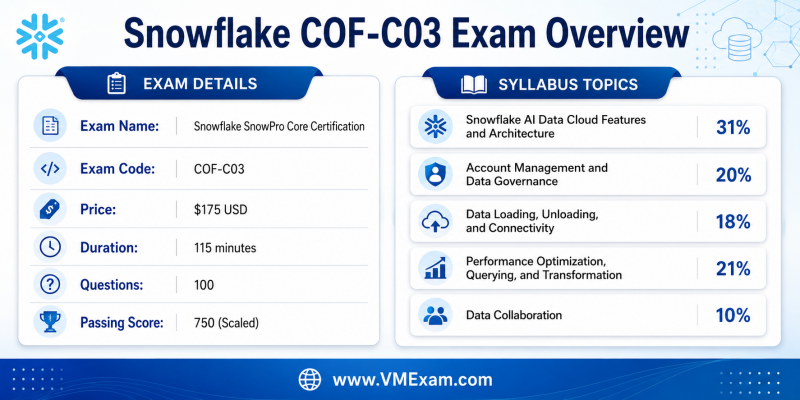
Exam Name: Snowflake SnowPro Core Certification
-
Exam Code: COF-C03
-
Exam Price: USD 175 for each attempt, which can be a significant investment for some.
-
Duration: Candidates are allotted 115 minutes to complete the examination.
-
Number of Questions: The exam comprises 100 questions, primarily multiple-choice or multiple-response.
-
Passing Score: A scaled score of 750 or higher is required to pass, with scores ranging from 0 to 1000.
These details provide a clear roadmap for candidates, helping them understand the time commitment and performance expectations. Familiarity with the structure ensures a more confident approach on exam day.
Grasping Key Domain Knowledge for COF-C03
A comprehensive understanding of the Snowflake COF-C03 exam objectives is paramount for anyone aiming to pass. The exam's content is carefully segmented into several core domains, each carrying a specific weightage, reflecting their importance in real-world Snowflake operations. Diving into these areas systematically will build a robust knowledge base.
The primary domains covered in the Snowflake SnowPro Core exam include:
-
Snowflake AI Data Cloud Features and Architecture (31%): This section covers the fundamental concepts of Snowflake's unique architecture, virtual warehouses, and the overall AI Data Cloud features. Understanding how Snowflake handles data storage, computation, and cloud services is critical here.
-
Account Management and Data Governance (20%): Focuses on administrative tasks such as user and role management, access control, resource monitors, and data security features within Snowflake. This domain emphasizes best practices for securing and managing a Snowflake account.
-
Data Loading, Unloading, and Connectivity (18%): This domain tests knowledge of various methods for getting data into and out of Snowflake, including using Snowpipe, COPY INTO command, and external stages. It also covers connectivity options like JDBC/ODBC drivers and connectors.
-
Performance Optimization, Querying, and Transformation (21%): Candidates need to demonstrate proficiency in writing efficient SQL queries, understanding query profiles, and utilizing features like clustering, caching, and materialized views to optimize performance. Data transformation techniques using SQL are also key.
-
Data Collaboration (10%): This domain covers Snowflake's capabilities for secure data sharing through features like Snowflake Data Marketplace and data exchange. It highlights how organizations can share and receive data seamlessly.
Candidates should allocate study time according to these percentages, ensuring deeper focus on higher-weighted domains while not neglecting any area. Accessing the downloadable study guide can offer further insights into each topic.
Unlocking Career Growth with SnowPro Core
Achieving the Snowflake SnowPro Core certification can significantly boost a professional's career trajectory, especially in a data-driven world. This credential demonstrates a validated skill set in a highly sought-after cloud data platform, making individuals more competitive in the job market. It opens doors to new opportunities and strengthens one's position within existing roles.
The benefits of holding a SnowPro Core certification extend beyond mere resume enhancement:
-
Enhanced Credibility: It serves as an industry-recognized validation of your foundational Snowflake skills, instilling confidence in employers and clients.
-
Career Advancement: Many organizations prioritize certified professionals for roles involving data warehousing, data engineering, and analytics on Snowflake.
-
Increased Earning Potential: While specific figures vary, certified professionals often command higher salaries due to their specialized and verified expertise. The demand for Snowflake professionals is growing.
-
Deeper Platform Understanding: The preparation process itself provides a structured learning path that solidifies a comprehensive understanding of Snowflake's capabilities and best practices.
-
Foundation for Advanced Certifications: SnowPro Core is the prerequisite for more specialized SnowPro certifications, laying the groundwork for further career specialization.
This certification is a strategic investment for anyone looking to solidify their expertise in cloud data management and position themselves for future growth.
Identifying Ideal Candidates for Snowflake COF-C03
The Snowflake COF-C03 exam is specifically tailored for a range of professionals seeking to validate their core Snowflake skills. While it's labeled a "Core" certification, it implies a foundational understanding that can benefit various roles within a data ecosystem. Determining if you are an ideal candidate involves assessing your current role, experience level, and career aspirations.
Typically, this certification is best suited for:
-
Data Engineers: Those involved in designing, building, and maintaining data pipelines and ETL processes who need to leverage Snowflake efficiently.
-
Data Analysts: Professionals who regularly query, analyze, and report on data stored in Snowflake and want to deepen their understanding of the platform's capabilities.
-
Database Administrators (DBAs): Individuals managing databases and seeking to transition or expand their skills into cloud-native data platforms like Snowflake.
-
Cloud Professionals: Anyone working with cloud infrastructure (AWS, Azure, GCP) who needs to integrate or manage data solutions within the Snowflake environment.
-
Beginners in Data Warehousing: Professionals new to data warehousing concepts but eager to gain a recognized credential in a leading cloud data platform.
-
Sales and Pre-Sales Engineers: Individuals who need a strong technical understanding of Snowflake to articulate its value proposition and capabilities to clients.
If your role involves interacting with data in the cloud, especially with a focus on scalable and flexible data solutions, the SnowPro Core certification can significantly benefit your professional profile.
Developing Your Effective Study Plan
A structured and comprehensive study plan is crucial for successfully passing the Snowflake COF-C03 exam. Given the breadth of topics, a haphazard approach can lead to inefficiencies and missed knowledge areas. Crafting a methodical plan ensures all exam objectives are covered thoroughly, maximizing your chances of success.
Consider these steps when building your study strategy:
-
Review the Official Study Guide: Start with the official study guide provided by Snowflake. This document outlines the exam objectives, providing a detailed breakdown of what you need to know for each domain.
-
Assess Your Current Knowledge: Take an initial practice test or self-assessment to identify your strengths and weaknesses across the syllabus domains. This helps in prioritizing areas that require more attention.
-
Allocate Study Time: Based on the exam objectives and your self-assessment, create a realistic study schedule. Allocate more time to challenging domains or those with higher weightage.
-
Utilize Diverse Resources: Don't rely on a single source. Combine official Snowflake documentation, online courses, video tutorials, and community forums.
-
Hands-on Practice: Snowflake is a practical platform. Set up a free trial account and practice SQL queries, data loading, virtual warehouse management, and security features. Practical application solidifies theoretical knowledge.
-
Regular Review and Revision: Periodically review previously studied topics to reinforce learning. Flashcards, summary notes, and self-quizzing are effective revision tools.
Consistency and dedicated effort will yield the best results. Treat your study plan as a project, with clear milestones and regular check-ins to monitor your progress.
Mastering Official Snowflake COF-C03 Preparation Material
Beyond a general study plan, focusing on official preparation materials is a cornerstone of success for the Snowflake COF-C03 exam. These resources are directly aligned with the exam content and often provide the most accurate and in-depth information. Leveraging them effectively can significantly reduce study time and improve comprehension.
Key official resources and how to use them:
-
Snowflake Documentation: The official Snowflake documentation is an invaluable, authoritative source. It covers every feature, function, and concept in detail. Regularly refer to it for in-depth explanations, syntax examples, and best practices.
-
SnowPro Core Study Guide: As mentioned, this guide provides a direct outline of the exam's domains and objectives. Use it as a checklist to ensure you cover every required topic.
-
Snowflake University Courses: Snowflake offers various training courses, some of which are specifically designed to prepare candidates for the SnowPro Core exam. These courses often include hands-on labs, expert instruction, and structured modules.
-
Snowflake Community and Forums: Engage with the official Snowflake Community. This platform allows you to ask questions, learn from others' experiences, and stay updated on new features and best practices.
-
Hands-on Labs and Demos: Snowflake frequently provides labs and demo environments. Actively participate in these to apply theoretical knowledge, troubleshoot issues, and build practical muscle memory.
Integrating these official resources into your study routine ensures you are learning directly from the source and preparing with information most relevant to the exam.
Leveraging Practice Tests for Exam Readiness
Utilizing COF-C03 Snowflake SnowPro Core practice tests is an indispensable part of any effective preparation strategy. These simulated exams do more than just test your knowledge; they familiarize you with the exam format, question types, and time constraints, building confidence and identifying areas for improvement before the actual test. Regular engagement with practice tests helps refine your approach.
Here's why practice tests are essential for your preparation:
-
Familiarization with Exam Format: Practice tests mimic the real exam environment, reducing anxiety on test day by making the format feel familiar.
-
Identifying Knowledge Gaps: By reviewing incorrect answers, you can pinpoint specific topics where your understanding is weak and focus your subsequent study efforts.
-
Time Management Skills: The timed nature of practice tests helps you learn to pace yourself, ensuring you can complete all questions within the allotted 115 minutes.
-
Understanding Question Nuances: Snowflake exam questions can sometimes be tricky or require careful reading. Practice tests expose you to these nuances, improving your ability to interpret questions correctly.
-
Building Confidence: Consistently performing well on practice tests can significantly boost your confidence, helping you approach the actual exam with a positive mindset.
For comprehensive practice questions that align with the SnowPro Core exam, consider exploring resources like VMExam.com. They offer simulated testing environments designed to help you gauge your readiness.
Understanding the Certification Journey
Navigating the Snowflake SnowPro Core certification path involves more than just studying for the exam. It encompasses a journey from initial interest to eventual certification and beyond, requiring strategic planning and understanding of each phase. A clear overview of this journey helps candidates set realistic expectations and stay motivated.
The typical SnowPro Core certification journey includes:
-
Initial Exploration: Researching the certification, understanding its scope, and aligning it with your career goals. This involves reviewing the exam objectives and prerequisites.
-
Structured Preparation: Dedicating time to study using official documentation, online courses, and hands-on practice, as outlined in previous sections.
-
Practice and Assessment: Regularly taking practice tests to assess readiness, identify gaps, and refine time management skills. This iterative process is key to mastery.
-
Exam Registration: Scheduling the exam once you feel confident and prepared. Be aware of the exam cost and any registration requirements.
-
Taking the Exam: Performing under timed conditions, applying all your learned knowledge and test-taking strategies.
-
Receiving Results and Certification: Awaiting your score and, upon passing, receiving your digital badge and certification credential.
-
Continuing Education: Snowflake's platform evolves. Staying updated with new features and considering advanced SnowPro certifications is part of ongoing professional development.
Each step contributes to a successful certification outcome and continuous growth in the Snowflake ecosystem.
Financial Considerations: Snowflake SnowPro Core Cost
While the benefits of the Snowflake SnowPro Core certification are clear, understanding the financial investment involved is a practical consideration for many candidates. The Snowflake SnowPro Core certification cost primarily revolves around the exam fee, but potential additional expenses for study materials and practice tests should also be factored in. Budgeting effectively ensures a smooth certification process without unexpected financial burdens.
Key cost components for the SnowPro Core certification typically include:
-
Exam Registration Fee: The most significant direct cost is the exam fee itself, which is $175 USD. This fee is per attempt, so retakes will incur additional costs.
-
Official Training Courses: While not mandatory, many candidates opt for official Snowflake University courses or instructor-led training, which can range from a few hundred to over a thousand dollars depending on the depth and duration.
-
Third-Party Study Guides/Practice Tests: High-quality third-party study guides, video courses, or practice test subscriptions can also add to the cost, usually ranging from $50 to $200.
-
Hands-on Lab Environment: While Snowflake offers a free trial, extended usage or specific lab environments for complex scenarios might sometimes incur minimal cloud usage costs, though this is often negligible for study purposes.
Candidates should weigh these costs against their personal budget and the potential return on investment in terms of career advancement and salary.
Weighing the Benefits: Is SnowPro Core Worth It?
The question "is Snowflake SnowPro Core certification worth it?" is frequently asked by aspiring data professionals. The value of any certification hinges on its relevance to industry demand, its impact on career progression, and the actual skills it validates. For Snowflake, a rapidly growing cloud data platform, the SnowPro Core holds considerable weight in today's job market.
Several factors indicate its strong value:
-
High Industry Demand: Snowflake continues to be adopted by numerous enterprises, leading to a high demand for professionals skilled in its platform. Certification helps meet this demand.
-
Foundational Expertise: It validates core competencies that are essential for almost any role interacting with Snowflake, providing a solid base for specialization.
-
Competitive Advantage: In a competitive job market, certifications can differentiate candidates, signaling dedication and verified expertise to potential employers.
-
Skill Refresh and Validation: For experienced professionals, it’s an excellent way to refresh knowledge, learn best practices, and validate existing skills.
-
Gateway to Advanced Roles: As the foundational certification, it's often a prerequisite or highly recommended stepping stone for more advanced SnowPro certifications in areas like Data Engineering, Data Architecture, or Administrator.
Given the platform's prevalence and the comprehensive skills validated, the Snowflake SnowPro Core certification is generally considered a valuable asset for career development in the data analytics and engineering fields.
Strategies for Overcoming Common Exam Hurdles
Even with thorough preparation, candidates may encounter common challenges during the Snowflake COF-C03 exam. Recognizing and proactively addressing these hurdles can significantly improve performance and reduce stress on exam day. Developing effective strategies to manage these obstacles is as important as mastering the technical content.
Typical exam hurdles and how to approach them:
-
Time Pressure: With 100 questions in 115 minutes, pacing is crucial. Practice tests under timed conditions are the best way to improve speed and accuracy. Learn to quickly identify questions you can answer and flag those requiring more thought.
-
Tricky Question Wording: Some questions may be phrased to test your attention to detail or nuanced understanding. Read each question and all answer options carefully before selecting. Eliminate obviously incorrect answers first.
-
Forgetting Syntax/Commands: While the exam focuses on concepts, some questions might relate to command-line tools or SQL syntax. Hands-on practice and creating quick reference sheets during study can help cement these details.
-
Overlooking Specific Features: Snowflake has many features. Ensure your study covers the purpose and application of each feature mentioned in the syllabus, even those you might not use daily.
-
Anxiety and Stress: Exam anxiety can impair performance. Practice relaxation techniques, ensure you get adequate rest before the exam, and arrive early to the testing center to minimize last-minute stress.
A calm, prepared, and strategic mindset will go a long way in successfully navigating these common exam difficulties.
Navigating the Re-certification Process
To ensure SnowPro Core certified professionals maintain up-to-date knowledge with the evolving Snowflake platform, a re-certification process is in place. Technology progresses rapidly, and maintaining a current certification status demonstrates ongoing commitment to expertise. Understanding this process ensures your credential remains valid and relevant.
While specific re-certification policies can evolve, general principles often include:
-
Validity Period: Snowflake SnowPro Core certifications typically have a validity period, often two years from the date of issuance. After this period, the certification expires.
-
Re-certification Exam: To re-certify, professionals are generally required to pass a re-certification exam. This exam may be a condensed version of the original exam or focus specifically on new features and updates released since your initial certification.
-
Stay Updated: The best way to prepare for re-certification is to continuously engage with Snowflake's platform, documentation, and release notes. This ensures you're aware of new functionalities and best practices.
-
No Automatic Extension: Unlike some certifications, there is typically no automatic extension based on activity. You must actively pass the re-certification exam.
-
Planning Ahead: Mark your certification expiration date and plan your re-certification efforts well in advance to avoid a lapse in your credential.
Staying current with your certification is a testament to your ongoing professional development and commitment to the Snowflake ecosystem.
Real-World Application of SnowPro Core Skills
The skills validated by the Snowflake COF-C03 certification are not merely theoretical; they have direct and significant real-world application in various professional settings. Understanding how these core competencies translate into practical tasks helps candidates appreciate the value of their certification and articulate their capabilities to employers. The SnowPro Core certification prepares you for tangible responsibilities.
Professionals with SnowPro Core certification can expect to:
-
Efficiently Load and Unload Data: Utilize Snowpipe, COPY INTO, and other methods to seamlessly move data between various sources and Snowflake, crucial for data ingestion pipelines.
-
Optimize Query Performance: Write and optimize SQL queries, understand query profiles, and implement techniques like clustering and partitioning to ensure fast and cost-effective data retrieval.
-
Implement Data Governance: Apply roles, users, and access control mechanisms to secure data and manage privileges effectively within the Snowflake environment.
-
Manage Virtual Warehouses: Scale virtual warehouses up or down based on workload demands, optimizing compute resources for different tasks and controlling costs.
-
Facilitate Data Sharing: Leverage Snowflake's data sharing capabilities to securely share data internally or externally with business partners and customers.
-
Understand Snowflake Architecture: Comprehend the unique micro-partitioning, storage, and compute separation that underpins Snowflake's performance and elasticity, enabling better solution design.
These practical applications demonstrate the immediate value that SnowPro Core certified individuals bring to any organization leveraging the Snowflake AI Data Cloud.
Building a Strong Snowflake Expertise Portfolio
Beyond passing the Snowflake COF-C03 exam, actively building a portfolio that showcases your Snowflake expertise can significantly enhance your professional profile. A certification validates knowledge, but a practical portfolio demonstrates the ability to apply that knowledge to solve real-world problems. This proactive approach can make you stand out to recruiters and hiring managers.
Consider these elements for your portfolio:
-
Personal Snowflake Projects: Develop small projects demonstrating data loading, transformation (using SQL or Python/Snowpark), and querying. Examples could include analyzing public datasets.
-
SQL Query Repository: Maintain a collection of complex or optimized SQL queries you've written for various data manipulation and analysis tasks in Snowflake.
-
Data Pipeline Demonstrations: Showcase how you've integrated Snowflake with other tools (e.g., dbt, Fivetran, Python scripts) for end-to-end data processing.
-
Documentation of Best Practices: Share examples of how you've implemented Snowflake best practices for cost optimization, security, or performance.
-
Contribution to Community Forums: Active participation in the Snowflake Community, answering questions or sharing insights, can highlight your expertise and willingness to help others.
-
Blog Posts or Articles: Write about specific Snowflake features, common challenges, or innovative solutions you've discovered, further solidifying your thought leadership.
A well-curated portfolio, combined with your SnowPro Core certification, provides compelling evidence of your practical skills and dedication to the Snowflake platform.
Last-Minute Review Tactics for COF-C03
As the Snowflake COF-C03 exam day approaches, employing effective last-minute review tactics can significantly solidify your understanding and boost your confidence. This final push should focus on consolidation and quick recall rather than attempting to learn new, extensive topics. Strategic review ensures that critical information is fresh in your mind.
Consider these tactics for your final review:
-
Review Key Concepts and Definitions: Go over your summary notes, flashcards, or a concise cheat sheet covering fundamental terms, architecture components, and core features.
-
Revisit High-Weighted Domains: Briefly re-read the sections corresponding to the higher-weighted domains in the syllabus to reinforce the most impactful knowledge.
-
Practice Challenging Questions: Focus on practice questions you previously struggled with or found particularly difficult. Understand the correct answers and the reasoning behind them.
-
Understand Snowflake Architecture Diagram: A quick review of the Snowflake architecture diagram can help visualize how different components interact, aiding in answering conceptual questions.
-
SQL Syntax Refresher: Briefly look over common SQL commands and Snowflake-specific functions. While not a coding exam, understanding syntax for data manipulation is beneficial.
-
Rest and Relax: Most importantly, ensure you get a good night's sleep before the exam. A well-rested mind performs better than an over-crammed one. Avoid last-minute panic studying.
These focused review efforts will help ensure you enter the exam room feeling prepared and mentally sharp, ready to tackle the challenges ahead.
Achieving Your Snowflake Certification Goal
The Snowflake COF-C03 exam represents a significant milestone for data professionals aiming to establish their expertise in the Snowflake AI Data Cloud. By systematically approaching your preparation, understanding the exam's nuances, and leveraging available resources, you can confidently work towards achieving this valuable certification. The journey requires dedication, hands-on practice, and a strategic mindset. The SnowPro Core credential not only validates your foundational knowledge but also opens doors to advanced career opportunities and a deeper engagement with one of the most innovative data platforms today.
The path to becoming Snowflake SnowPro Core certified is both challenging and rewarding. It requires commitment to learning and a strategic approach to mastering the platform's features and functionalities. Embrace the learning process, engage with the Snowflake community, and utilize practice tests to hone your skills. Your diligence will pave the way to success and enhance your professional standing in the rapidly evolving data landscape. Ready to elevate your data career? Start your preparation journey today to become a certified Snowflake professional. Discover a wealth of expert certification resources and practice opportunities at VMExam.com.
Frequently Asked Questions
1. What is the Snowflake SnowPro Core certification?
The Snowflake SnowPro Core certification, identified by exam code COF-C03, validates an individual's foundational knowledge of the Snowflake platform, covering its architecture, data loading, performance optimization, and data governance features.
2. How long is the Snowflake COF-C03 exam?
Candidates are allotted 115 minutes to complete the Snowflake COF-C03 examination, which consists of 100 questions.
3. What is the passing score for the Snowflake SnowPro Core exam?
A scaled score of 750 or higher, out of a possible 1000, is required to pass the Snowflake SnowPro Core certification exam.
4. Is hands-on experience necessary for the COF-C03 exam?
While the exam assesses conceptual knowledge, hands-on experience with the Snowflake platform is highly recommended. It helps solidify understanding of various features, data operations, and performance considerations discussed in the syllabus.
5. How often do I need to re-certify for Snowflake SnowPro Core?
Typically, the Snowflake SnowPro Core certification is valid for two years. To maintain your credential, you will generally need to pass a re-certification exam before your current certification expires.
- SnowPro Core Certification Exam Books |
- Snowflake Certified SnowPro Core Certification |
- SnowPro Core Certification Syllabus |
- SnowPro Core Certification Exam Prep Guide |
- SnowPro Core Certification Exam Price |
- SnowPro Core Certification Study Guide |
- SnowPro Core Certification Training |
- Snowflake SnowPro Core Certification Cert Guide |
- Snowflake Certified SnowPro Core Certification Questions and Answers |
- SnowPro Core Certification Online Test |
- SnowPro Core Certification Mock Test |
- Snowflake SnowPro Core Certification Exam Questions |
- Snowflake Associate and Core Certification |
- COF-C03 SnowPro Core Certification |
- COF-C03 Mock Test |
- COF-C03 Practice Exam |
- COF-C03 Prep Guide |
- COF-C03 Questions |
- COF-C03 Simulation Questions |
- COF-C03 |
- Snowflake COF-C03 Study Guide |
- SnowPro Core Certification Simulator |
- SnowPro Core Certification Mock Exam |
- Snowflake SnowPro Core Certification Questions |
- SnowPro Core Certification |
- Snowflake SnowPro Core Certification Practice Test |
- COF-C03 Books |
- COF-C03 Exam Cost


