
Advanced 3V0-23.25 Prep: What Experts Get Wrong
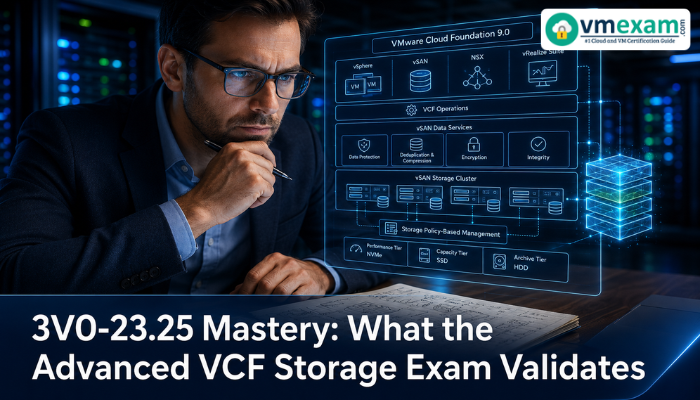 The Advanced VMware Cloud Foundation 9.0 Storage certification, identified by exam code 3V0-23.25, validates a candidate's advanced knowledge and skills in designing, deploying, and managing VMware Cloud Foundation (VCF) storage solutions. This credential is vital for experienced professionals aiming to demonstrate their expertise in complex VCF storage architectures, including VMware vSAN integration, data protection, and troubleshooting. Professionals who pursue the VMware 3V0-23.25 exam are typically senior storage architects, cloud administrators, or consultants responsible for enterprise-level VCF environments. This comprehensive article delves into critical aspects of preparing for the 3V0-23.25 exam, highlighting areas where even seasoned experts often make missteps and offering strategies to ensure thorough readiness.
Evaluating the Advanced VMware 3V0-23.25 Exam Structure
Understanding the examination framework is the foundational step for any certification pursuit. The VMware 3V0-23.25 exam is structured to rigorously test advanced competencies, ensuring certified professionals possess deep practical and theoretical knowledge. Candidates should approach this exam with a strategic mindset, recognizing the blend of technical depth and real-world application it demands.
Here are the key details for the Advanced VMware Cloud Foundation 9.0 Storage exam:
-
Exam Name: Advanced VMware Cloud Foundation 9.0 Storage
-
Exam Code: 3V0-23.25
-
Exam Price: $250 USD
-
Duration: 135 minutes
-
Number of Questions: 60
-
Passing Score: 300 / 500
These parameters indicate a challenging assessment requiring not just memorization but a profound understanding of VCF storage concepts. The time limit per question suggests a need for quick, accurate decision-making based on solid knowledge.
Navigating the VMware 3V0-23.25 Syllabus Domains
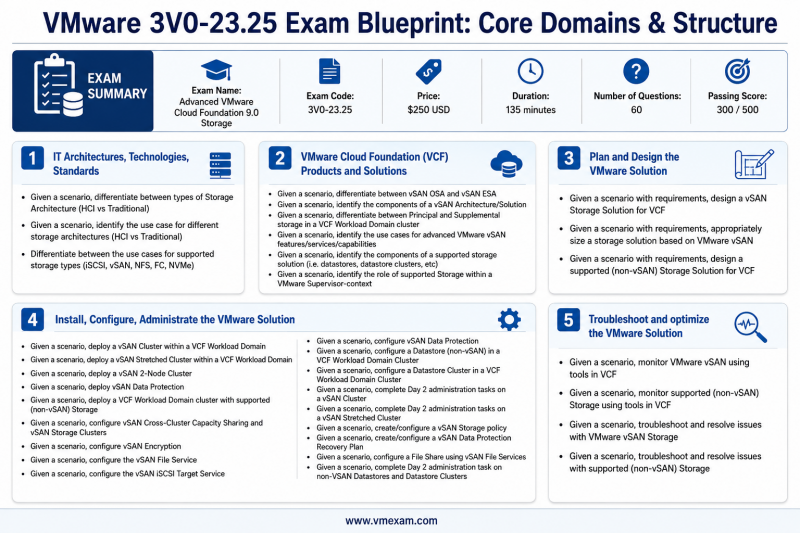
The Advanced VMware Cloud Foundation 9.0 Storage exam syllabus covers a wide array of topics crucial for managing complex VCF storage environments. A common pitfall for experienced professionals is to gloss over familiar topics, assuming their existing knowledge is sufficient. However, the 3V0-23.25 blueprint often tests nuances and advanced scenarios that require specific VCF context.
The syllabus is broken down into several core domains, each demanding focused attention:
-
IT Architectures, Technologies, Standards: This domain delves into the underlying architectural principles, industry technologies, and compliance standards relevant to modern data center storage and cloud infrastructures. It emphasizes how VCF storage integrates within a broader enterprise IT landscape, including considerations for regulatory requirements and performance benchmarks.
-
VMware Cloud Foundation (VCF) Products and Solutions: Candidates must demonstrate an in-depth understanding of the various components of VCF related to storage, such as vSAN, NSX-T, and how they interoperate within the VCF stack. This includes knowledge of supported storage types, deployment models, and the specific capabilities of VCF's integrated storage solutions.
-
Plan and Design the VMware Solution: This critical section focuses on the ability to translate business requirements into technical VCF storage designs. It covers capacity planning, performance considerations, fault tolerance, RTO/RPO objectives, and network requirements for storage traffic. Experts often underestimate the specific VCF design constraints versus generic vSphere knowledge here.
-
Install, Configure, Administrate the VMware Solution: Beyond basic setup, this domain tests advanced installation procedures, complex configuration options, and day-2 operations for VCF storage. This includes lifecycle management, applying vSAN storage policies in VCF, and integrating external storage systems if applicable.
-
Troubleshoot and optimize the VMware Solution: A significant portion of the exam assesses practical skills in diagnosing and resolving intricate storage-related issues within VCF. This includes performance optimization, identifying bottlenecks, resolving data accessibility problems, and ensuring data integrity through proper replication and protection mechanisms.
Each domain represents a pillar of expertise, and a balanced study approach is essential to pass the 3V0-23.25 exam successfully.
Debunking Common Expert Misconceptions in 3V0-23.25 Prep
Even highly experienced VMware professionals can stumble on the 3V0-23.25 exam. The "expert wrong" phenomenon often stems from a few critical misjudgments. These typically involve relying too heavily on general vSphere knowledge, underestimating VCF-specific integrations, or overlooking the advanced troubleshooting scenarios.
Over-Reliance on General vSphere Storage Expertise
Many experts possess extensive knowledge of vSphere storage concepts, including traditional SAN/NAS, vSphere Storage APIs (VASA), and datastore types. However, VCF fundamentally changes the storage paradigm by heavily leveraging vSAN as its primary storage foundation. While vSphere knowledge is a prerequisite, the exam demands a deep understanding of vSAN's unique architecture, policies, and operational nuances within the VCF context. This includes specific aspects like stretched clusters, fault domains, and how vSAN works with SDDC Manager. The exam specifically focuses on VMware vSAN in Cloud Foundation, which introduces a layer of integration and automation not present in standalone vSAN deployments.
Underestimating VCF-Specific Integration Complexities
VCF is an integrated solution, and its storage component (vSAN) doesn't operate in a vacuum. It's tightly coupled with NSX-T for networking, SDDC Manager for lifecycle management, and vRealize Suite for automation and operations. Experts sometimes fail to consider how these integrations impact storage design, deployment, and troubleshooting. For example, network segmentation configured in NSX-T directly affects vSAN traffic and resilience. The 3V0-23.25 blueprint will test this interconnectedness, expecting candidates to understand how changes in one VCF component can influence storage behavior.
Neglecting Advanced VCF Storage Design Guide Principles
VMware provides specific design guides and best practices for VCF, which often go beyond generic vSAN recommendations. These guides detail validated designs, reference architectures, and storage considerations unique to Cloud Foundation deployments. Experts who skip these official resources in favor of their own accumulated experience may miss crucial VCF-specific recommendations regarding scalability, resilience, and performance that are directly assessed in the exam. Familiarity with the official storage design guide is paramount.
Architecting VCF Storage: Advanced Design Principles
Designing a robust and scalable storage solution for VMware Cloud Foundation 9.0 requires more than just basic vSAN knowledge; it demands an understanding of advanced architectural principles tailored to VCF's integrated stack. The 3V0-23.25 exam emphasizes the ability to make informed design decisions that account for performance, capacity, resilience, and operational efficiency within a VCF environment.
Aligning Storage with SDDC Manager and Workload Domains
A key aspect of VCF storage design is its integration with workload domains managed by SDDC Manager. Each workload domain (e.g., management domain, VI workload domains) has specific storage requirements and sizing considerations. Experts must understand how to provision and scale vSAN capacity not just for individual VMs, but for entire workload domains, considering the underlying physical infrastructure and growth projections. This involves designing for predictable performance and ensuring alignment with VCF lifecycle management processes.
Implementing Advanced VMware vSAN Storage Policies in VCF
VMware vSAN storage policies in VCF are fundamental to defining storage service levels for virtual machines. The exam will test advanced policy configurations beyond simple FTT=1. This includes understanding the impact of various failure tolerance methods (RAID-1, RAID-5/6), object space reservation, flash read cache reservation, and IOPS limits. Designing the correct policy for different workloads (e.g., mission-critical databases, VDI, file servers) and understanding the trade-offs between performance, capacity, and resilience is crucial.
Planning for Data Protection and Replication within VCF
Advanced VCF storage architecture includes comprehensive data protection and replication strategies. This involves integrating solutions like VMware Site Recovery Manager (SRM) with vSAN stretched clusters, configuring vSphere Replication, and understanding the role of third-party backup solutions within a VCF context. Candidates need to design solutions that meet strict RTO and RPO objectives, considering network bandwidth, recovery site topology, and the overall disaster recovery plan for the entire Cloud Foundation instance. These VMware VCF data protection and replication strategies are critical for business continuity.
Optimizing vSAN in VMware Cloud Foundation Deployments
Optimization is a continuous process in any enterprise environment, and VCF storage is no exception. For the 3V0-23.25 exam, demonstrating expertise in fine-tuning vSAN performance and resource utilization within a VCF deployment is essential. This goes beyond initial configuration to address real-world performance challenges and efficiency goals.
Performance Tuning for VMware VCF Storage Solutions
Achieving optimal performance for VMware Cloud Foundation storage solutions involves careful monitoring, analysis, and adjustments. Experts must be proficient in identifying performance bottlenecks, which could stem from network latency, CPU contention, or disk I/O limitations on vSAN. Tools like vRealize Operations Manager and vCenter Server's performance charts are invaluable. Optimization strategies include:
-
Storage Policy Adjustment: Modifying vSAN storage policies to better match workload requirements, such as adjusting cache reservations or failure tolerance levels.
-
Network Configuration Review: Ensuring optimal network settings for vSAN traffic, including jumbo frames, proper teaming policies, and sufficient bandwidth for inter-node communication.
-
Disk Group Configuration: Analyzing and optimizing disk group configurations, considering flash-to-capacity device ratios and the type of disk devices used.
-
Workload Placement: Strategically placing demanding workloads across vSAN clusters or nodes to balance resource consumption and avoid hot spots.
These actions require a holistic understanding of how vSAN interacts with the entire VCF stack.
Capacity Management and Forecasting for VCF
Efficient capacity management is critical for sustaining VCF operations and avoiding costly expansions. The VMware 3V0-23.25 exam expects candidates to understand not just current capacity usage, but also how to forecast future needs based on workload growth, retention policies, and compliance requirements. This involves leveraging vRealize Operations to analyze trends, understanding the impact of various vSAN features (e.g., deduplication and compression), and planning for proactive scaling. Effective capacity planning also involves understanding VMware Cloud Foundation storage considerations for future-proofing designs.
Best Practices for VMware Cloud Foundation Storage Operations
Adhering to VMware Cloud Foundation storage best practices ensures stability, security, and optimal performance. This includes:
-
Regular health checks and diagnostics for vSAN and associated components.
-
Implementing proper patch and update procedures through SDDC Manager.
-
Adopting consistent naming conventions for vSAN objects and policies.
-
Establishing robust backup and recovery procedures for vSAN-backed workloads and the VCF management plane itself.
These operational practices contribute significantly to the long-term success and reliability of a VCF deployment.
Troubleshooting Intricate Storage Issues in VCF 9.0
The ability to diagnose and resolve complex storage issues is a hallmark of an advanced VCF professional. The VMware 3V0-23.25 exam includes challenging scenarios that test a candidate's systematic approach to troubleshooting and their deep understanding of VCF storage components and their interdependencies. This often involves correlating symptoms across different layers of the VCF stack.
Diagnosing vSAN Component Failures and Performance Degradation
Troubleshooting in VCF 9.0 often begins with identifying the root cause of vSAN component failures, such as disk group issues, network partition events, or object unavailability. This requires familiarity with vSAN health checks, vCenter alarms, and log analysis. Performance degradation troubleshooting can be particularly complex, demanding a keen eye for subtle indicators across storage I/O, network latency, and CPU utilization. Experts must distinguish between issues originating from the vSAN layer versus problems higher up in the application stack or external network.
Resolving Data Accessibility and Compliance Challenges
Scenarios involving data accessibility issues where VMs cannot access their storage are critical. This could be due to vSAN object failures, network connectivity problems, or incorrect storage policy assignments. The exam may also present challenges related to storage compliance, such as ensuring data locality, meeting regulatory retention requirements, or recovering from accidental data deletion using snapshots and backups. Proficiency in utilizing tools like RVC (Ruby vSphere Console) and vSAN Observer can be invaluable for advanced diagnostics. These skills are fundamental to VMware VCF storage troubleshooting.
Advanced Logging and Event Analysis for VCF Storage
Deep-seated storage problems in VCF often require meticulous analysis of logs and events from multiple sources: vCenter Server, ESXi hosts (specifically vSAN logs), NSX-T components, and SDDC Manager. The ability to correlate timestamps and error messages across these different logs to pinpoint the exact failure point or bottleneck is a critical skill tested in the 3V0-23.25 exam. This involves understanding the logging architecture of VCF and knowing which logs to check for specific storage-related symptoms.
Crafting an Effective 3V0-23.25 Preparation Strategy
A successful journey to Advanced VMware Cloud Foundation 9.0 Storage certification requires a well-structured and disciplined preparation strategy. Beyond simply studying the syllabus, candidates must engage in active learning and practical application to solidify their understanding. This advanced guide specifically highlights areas often overlooked by experienced individuals.
Leveraging Official VMware 3V0-23.25 Study Guide Materials
The official VMware 3V0-23.25 study guide and blueprint are your most reliable resources. These documents outline the specific topics, objectives, and potentially even the weighting of domains. Do not underestimate their importance, even if you feel proficient. They provide the definitive scope of the exam. Complementing these, official Broadcom (formerly VMware) documentation, whitepapers, and validated design guides for VCF 9.0 are indispensable for understanding advanced concepts and best practices.
Hands-on Experience with VMware Cloud Foundation
Theoretical knowledge alone is insufficient. Hands-on experience with a VMware Cloud Foundation environment is paramount. This includes deploying, configuring, administering, and troubleshooting storage within VCF. A personal lab, whether physical or nested, is highly recommended. Practical exercises should focus on:
-
Implementing various vSAN storage policies.
-
Performing scaling and expansion of vSAN clusters within workload domains.
-
Simulating component failures and practicing recovery procedures.
-
Configuring data protection and replication using SRM or vSphere Replication.
-
Utilizing command-line tools and APIs for advanced management tasks.
This practical application reinforces theoretical concepts and builds confidence for the scenario-based questions typical of advanced exams.
Utilizing Advanced VMware 3V0-23.25 Practice Exam Resources
Once a solid foundation of knowledge and hands-on experience is established, engaging with a high-quality VMware 3V0-23.25 practice exam becomes crucial. These practice tests help candidates:
-
Assess their readiness and identify knowledge gaps.
-
Become familiar with the exam format and question types.
-
Improve time management skills under simulated exam conditions.
-
Reinforce learning through detailed explanations of correct and incorrect answers.
However, it's critical to use reputable practice exam providers that offer original, high-quality questions, not brain dumps. Relying on unethical materials can lead to failure and devalue the certification. Ethical preparation is key to earning a credential that truly reflects your capabilities.
Career Advancement Through Advanced VCF Storage Expertise
Earning the Advanced VMware Cloud Foundation 9.0 Storage certification (3V0-23.25) signifies a high level of specialization and commitment, directly impacting career progression in the cloud infrastructure domain. This credential distinguishes professionals as experts capable of handling the most complex VCF storage challenges.
Expanding Role and Responsibilities in Cloud Infrastructure
Certified professionals often find themselves taking on more senior roles, leading design efforts for large-scale VCF deployments, or becoming subject matter experts within their organizations. The Advanced VMware VCF storage architecture skills validated by this exam are in high demand for roles such as Senior Cloud Architect, Principal Storage Engineer, or VCF Consultant. Employers seek individuals who can not only manage but also strategically plan and optimize sophisticated cloud storage solutions.
Validating Advanced Skill Sets and Industry Relevance
The 3V0-23.25 certification is a tangible validation of advanced skills in a rapidly evolving technology landscape. It confirms expertise in cutting-edge software-defined storage, hyperconverged infrastructure, and integrated cloud platforms. This relevance ensures that certified individuals remain competitive and indispensable as organizations increasingly adopt VCF for their hybrid cloud strategies. It demonstrates a commitment to mastering complex, critical infrastructure components.
Demonstrating Competence in Complex VMware Cloud Foundation Deployments
This certification proves a candidate's ability to tackle the intricate details of VMware Cloud Foundation storage deployment, including initial setup, scaling, optimization, and troubleshooting in highly demanding environments. It reassures employers that the individual can manage the full lifecycle of VCF storage, ensuring high availability, performance, and data integrity for critical business applications.
Conclusion
The VMware 3V0-23.25 Advanced VMware Cloud Foundation 9.0 Storage exam is a rigorous validation of expertise in VCF storage architecture, design, and operations. Success hinges on a comprehensive preparation strategy that goes beyond general knowledge, focusing specifically on VCF's integrated nature, advanced vSAN capabilities, and official best practices. By addressing common expert pitfalls—such as underestimating VCF-specific complexities and neglecting official design guides—candidates can achieve true mastery.
For those ready to validate their advanced VCF storage skills, a strategic and ethical preparation approach is indispensable. To further enhance your study efforts and test your readiness, explore additional training resources and practice opportunities. Find comprehensive study materials and practice exams designed to sharpen your skills and prepare you thoroughly for this challenging certification on VMware exam preparation.
FAQs
1. What is the primary focus of the VMware 3V0-23.25 certification?
The VMware 3V0-23.25 certification primarily focuses on validating advanced knowledge and skills in designing, deploying, administering, and troubleshooting storage solutions within VMware Cloud Foundation (VCF) 9.0 environments, particularly emphasizing vSAN integration.
2. Why do experienced professionals sometimes struggle with the 3V0-23.25 exam?
Experienced professionals may struggle due to over-reliance on general vSphere storage knowledge, underestimating VCF-specific integrations with components like SDDC Manager and NSX-T, or not thoroughly reviewing official VCF storage design guides and best practices.
3. How important is hands-on experience for this exam?
Hands-on experience is critically important for the 3V0-23.25 exam. The certification tests practical application and troubleshooting scenarios, making direct experience with VCF storage deployments, configurations, and problem-solving in a lab environment invaluable for success.
4. What kind of preparation materials are most effective for advanced exams like 3V0-23.25?
Effective preparation materials include the official VMware 3V0-23.25 study guide and blueprint, official Broadcom/VMware VCF documentation, validated design guides, and high-quality practice exams from reputable providers. Combining these with extensive hands-on lab work is recommended.
5. What career benefits can I expect after earning the Advanced VMware Cloud Foundation 9.0 Storage certification?
Earning this certification can lead to career advancement into senior architect or consultant roles, validate advanced skill sets in highly demanded cloud infrastructure technologies, and demonstrate expertise in managing complex, integrated VMware Cloud Foundation deployments, enhancing professional credibility and marketability.
- VMware Cloud Foundation Certification |
- 3V0-23.25 Advanced VMware Cloud Foundation Storage |
- 3V0-23.25 Mock Test |
- 3V0-23.25 Practice Exam |
- 3V0-23.25 Prep Guide |
- 3V0-23.25 Questions |
- 3V0-23.25 Simulation Questions |
- 3V0-23.25 |
- VMware Certified Advanced Professional - VMware Cloud Foundation Storage Questions and Answers |
- Advanced VMware Cloud Foundation Storage Online Test |
- Advanced VMware Cloud Foundation Storage Mock Test |
- VMware 3V0-23.25 Study Guide |
- Advanced VMware Cloud Foundation Storage Exam Questions |
- Advanced VMware Cloud Foundation Storage Cert Guide |
- Advanced VMware Cloud Foundation Storage Certification Mock Test |
- Advanced VMware Cloud Foundation Storage Simulator |
- Advanced VMware Cloud Foundation Storage Mock Exam |
- Advanced VMware Cloud Foundation Storage Questions |
- Advanced VMware Cloud Foundation Storage |
- Advanced VMware Cloud Foundation Storage Practice Test |
- 3V0-23.25 Books |
- 3V0-23.25 Exam Cost |
- 3V0-23.25 Passing Score |
- 3V0-23.25 Syllabus |
- Advanced VMware Cloud Foundation Storage Exam Books


